Lemon eucalyptus is a tall Australian tree whose leaves smell of lemon: its essential oil scents the house, but against mosquitoes, the little bottle isn’t enough.
Who he really is
Family: Myrtle family (Myrtaceae). Lemon eucalyptus comes from eastern Australia, from Queensland to north-eastern New South Wales. Today it’s planted in plenty of other countries, above all Brazil and China.
Part used: the leaves, and the essential oil made from them.
Lemon eucalyptus is a tall Australian tree whose leaves smell of lemon when you crush them. Its essential oil is used for scent, and mosquito repellents are made from it too. I keep one in a pot on the terrace, for the smell, and the bottle lives on the top shelf of the cupboard.
His story
Lemon eucalyptus is a tall Australian tree whose leaves smell of lemon when you crush them. At my place, it lives in a big pot on the terrace and comes inside as soon as there’s frost. I use its essential oil to scent the house. And I’ll tell you straight away what I don’t do with it: I don’t swallow it, and I don’t count on it against mosquitoes.
Lemon eucalyptus: what kind of tree is it?
His proper name, these days, is Corymbia citriodora. He belongs to the myrtle family, like all eucalyptus trees. At home, he grows in eastern Australia, from Queensland down to north-eastern New South Wales, in open forest and woodland on the hills.
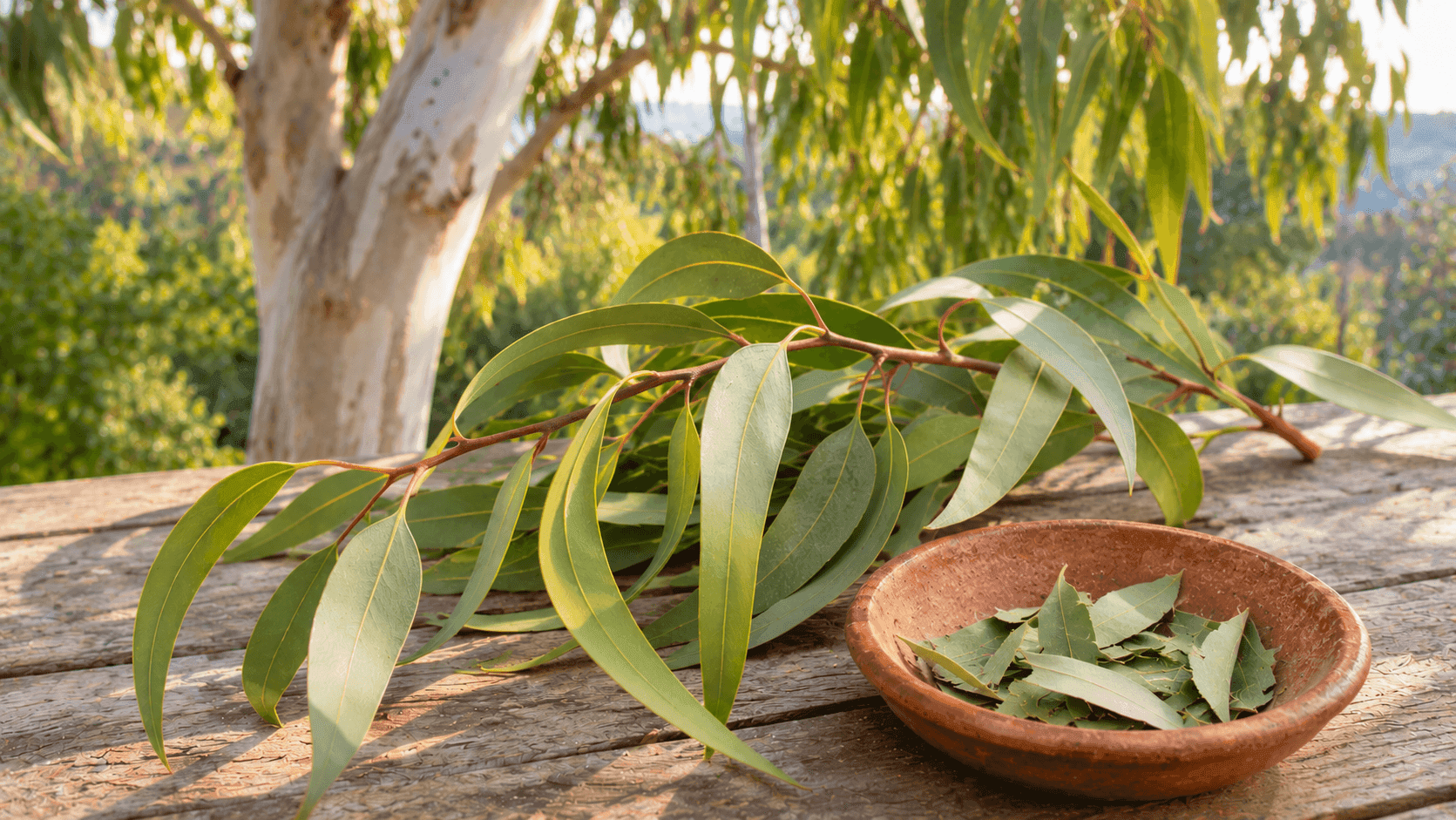
Over there, he’s a giant: he can reach 50 m. His trunk is smooth, white, pink or coppery, often a little powdery, and the bark comes off in thin flakes that curl up. His adult leaves are long and narrow, glossy green on both sides. His flowers are white, and his fruits are little woody capsules shaped like urns. The leaves smell of lemon when you crush them, but not everywhere: in the south of his range, there are trees of the same species whose leaves smell of nothing at all.
I love the story of his name. His first names come from an expedition into tropical Australia, the one led by the explorer Thomas Mitchell, in 1846. In 1848, in the account of that journey, the botanist William Hooker called him Eucalyptus citriodora: Latin for “lemon-scented”. In the same book, another botanist, Lindley, had given him another name, Eucalyptus melissiodora. When I hear that one, I think of my lemon balm, the other lemon-scented herb at the edge of my vegetable patch.
In 1995, two botanists moved him into another genus, Corymbia. Lots of people, and lots of labels, still call him Eucalyptus citriodora. It’s the same tree.
Where I live, he doesn’t like the cold. English gardeners say he only stays outdoors in mild spots, down to about -5 °C, in full sun and sheltered from the wind, facing south or west. Anywhere else, he spends the winter under glass. Mine lives in a big pot against the house wall, and as soon as frost is forecast, I bring him in. He’s no giant: he comes up to my shoulder, and that suits me fine.
Lemon eucalyptus, globulus or radiata: don’t mix up your eucalyptus
When someone says “eucalyptus”, I think of the throat sweets of my childhood. Lemon eucalyptus smells of lemon, and he’s a different tree.
Eucalyptus globulus, also called Tasmanian blue gum, comes from Tasmania and the south of Australia. His young leaves are covered in a waxy blue-grey bloom, hence the name. It’s from him, and two close cousins, that the pharmacy books take eucalyptus oil for a cough with a cold. Lemon eucalyptus isn’t one of them. So if you were looking for lemon eucalyptus for a cold, he isn’t the one you need: ask your pharmacist. Even globulus oil has its rules: never before age 2, and not before age 3 on the skin or breathed in.
Narrow-leaved peppermint, Eucalyptus radiata, grows on the tablelands of New South Wales and along the coast of Victoria. Its crushed leaves smell of peppermint, not lemon. In the shops, bottles of radiata and lemon eucalyptus look very much alike: read the Latin name on the label carefully.
And citronella isn’t him either. Citronella oil comes from tall grasses from hot countries, part of the grass family. Same lemon scent, different plant. Everything I tell you here is about lemon eucalyptus, Corymbia citriodora, and only him.
Lemon eucalyptus essential oil: what I do with it, and what I don’t
Lemon eucalyptus essential oil is made from the leaves and twigs, distilled with steam. Most of it comes from Brazil and China, and perfumers use it.
People often ask me what its benefits are. I’ll give you an honest answer: my pharmacy books don’t give it any use at home. No cup, no measure, nothing. At my place, this little bottle is for one thing: scent.
An essential oil is natural, but it’s a very concentrated product. This one, undiluted, can irritate the skin, and like a lot of essential oils, it can cause allergies. So I have my rules, the same as for my lavender.
It isn’t for swallowing: not neat, not in a glass of water, not on a sugar lump. It never goes neat on the skin, or in the eyes, nose, mouth or ears. If you tend to have allergies, always do an allergy test before using it, and ask your pharmacist how to do it. After touching it, wash your hands well. And don’t go out in the sun straight afterwards: a lot of essential oils make the skin sensitive to sunlight.
For a diffuser, I use a device made for the job, I never heat the oil, I follow the leaflet and I air the room well. How many drops, how many minutes? I won’t make it up: my books don’t say, it’s the leaflet that counts, and your pharmacist if you’re unsure. I wrote down all my diffuser rules in my letter about evening drops.
And some people go without: children, women who are pregnant or breastfeeding, and anyone with asthma or delicate lungs. Older people, and anyone with a long-standing health problem, ask their doctor first. The bottle goes on the top shelf, never next to the baby things.
“A lemon-scented tree on the terrace, a bottle on the top shelf: for me, lemon eucalyptus is a smell first of all.”
Lemon eucalyptus and mosquitoes, tiger mosquito included: what really works
It’s the question I get asked most, ever since the tiger mosquito settled in. By early 2026, it had spread to 83 of the 96 départements of mainland France, and it’s out and about from May to November. So, does lemon eucalyptus keep mosquitoes away? Yes and no, and the difference matters.
It isn’t the little bottle of essential oil that protects you. On its own, this tree’s essential oil doesn’t keep mosquitoes away, the health books say. And essential oils evaporate too fast: on the skin, they usually last less than 20 minutes, and they can irritate the skin or make it sensitive to sunlight. The health books don’t recommend them against mosquitoes, citronella included.
The repellent people talk about is something else: a product made from the tree’s oil, reworked. On the label, you’ll read “Eucalyptus citriodora oil, hydrated, cyclized”, or PMD, which is the man-made version. Up to 2025, the health books listed it among the recommended repellents, roughly as effective as the classic ones against mosquitoes, but never under 3 years old, and well away from the eyes, because it stings them badly. Then the village pharmacist explained to me what changed in the summer of 2026: this product made from the tree is still waiting for its European assessment, PMD hasn’t been approved in Europe, and no repellent based on it has a marketing authorisation in France. So the French recommendations no longer say to use it. You choose a repellent that has that authorisation: on the label, it has a number starting with FR.
At my place, it’s an authorised repellent, a cream or lotion rather than a spray, only on the skin your clothes don’t cover. For a baby under one, it’s a mosquito net over the cot or the pushchair.
And the best habit costs nothing. Tiger mosquito larvae grow in still water, even in a saucer. So, from May to November, once a week, I walk round the garden: I empty the saucers, the watering cans and the buckets, I put sand in the saucers under the pots, and I cover my rain butt with a net. The potted plants sold against mosquitoes, geranium, citronella, lavender, smell lovely, but they don’t always stop them biting, and neither does my tree. And if you’ve already been bitten, here’s what I do for a bite that itches.
What I use him for
- · 01Passing by on the terrace: a leaf crushed between my fingers, for the lemon smell.
- · 02To scent the house: the essential oil in a diffuser made for the job, at the dose on the leaflet, the room well aired, and never when there’s a child, a pregnant or breastfeeding woman, or someone with asthma in the room.
- · 03For an evening outdoors in summer: long clothes and an authorised repellent from the pharmacy, with a number starting with FR on the label. Not the bottle of essential oil, and for now, not the repellent made from the tree either, which has no authorisation in France and isn’t recommended any more.
- · 04From May to November, once a week: a walk round the garden for standing water, against the tiger mosquito.
How I prepare him
Granny’s little recipes
My Saturday round against the tiger mosquito
From May to November, once a week
What you’ll need
- Some sand, for the saucers under the pots
- A net or an old piece of cloth, to cover the rain butt
How I go about it
- 01Walk round the garden and the terrace, and empty any standing water: saucers, watering cans, buckets, toys, tarpaulins.
- 02Fill the saucers under the pots with sand: the plant keeps its water, and the mosquito can’t find open water to lay her eggs.
- 03Cover the rain butt with a net stretched tight, and stretch one between the end of the gutter and the surface of the water too.
- 04Check the rain butt for larvae: if there are any, empty the water. And do it all again the following week, until November.
A summer evening on the terrace, without being eaten alive
A July evening, before dinner outdoors
What you’ll need
- Light-coloured, long, loose clothes
- Your sun cream, if the sun is still strong
- An authorised repellent from the pharmacy (a number starting with FR on the label), as a cream or lotion
- An electric fan
How I go about it
- 01Dress in light, long, loose clothes: the repellent is only for the skin that shows.
- 02If you need sun cream, put it on first, then wait at least 20 minutes before the repellent.
- 03Read the leaflet: the age, the amount and the number of applications a day are all written there. Put the repellent on bare skin, never near the eyes or mouth, and not on broken skin. For a child under 12, you put it on for them, and never on their hands or face.
- 04Switch the fan on near the table. And in the evening, before bed, wash with soap and water wherever you put the repellent.
Elsewhere: how others know him
My friend in Brazil wrote to tell me that over there they call him eucalipto-limão, lemon eucalyptus, or eucalipto-cheiroso, the sweet-smelling eucalyptus. He’s one of the most widely planted eucalyptus trees in Brazil: for timber, for posts, and for the oil made from the leaves. Together with China, Brazil produces most of it.
My daughter, in Shanghai, taught me his Chinese name: 柠檬桉, níngméng ān, lemon eucalyptus too. Wherever he grows, it’s his smell that gives him his name.
What I like is simpler: as I pass by on the terrace, I crush a leaf from my potted tree, and for a good minute my whole hand smells of lemon.
What to know first
This information doesn’t replace advice from a healthcare professional. Health Disclaimer →
His identity card
- Name
- Lemon eucalyptus
- Other names
- Eucalyptus citriodora (his old Latin name)
- Latin name
- Corymbia citriodora (Hook.) K.D.Hill & L.A.S.Johnson
- Family
- Myrtle family (Myrtaceae)
- Part used
- The leaves, and the essential oil made from them
- Harvest
- Leaves and twigs, distilled with steam
- Form
- Essential oil for scent; crushed leaf for the smell
- Origin
- Eastern Australia, from Queensland to New South Wales
- Storage
- Bottle tightly closed, up high, out of children’s reach
If you remember just one thing
- 01Lemon eucalyptus is Corymbia citriodora, a tall Australian tree whose leaves smell of lemon. It isn’t Eucalyptus globulus, or Eucalyptus radiata, or citronella.
- 02Its essential oil is for scent. It isn’t for swallowing, never goes neat on the skin, and it’s not for children, or during pregnancy and breastfeeding.
- 03Against mosquitoes, the bottle of essential oil doesn’t last long enough, and the repellent made from the tree has no authorisation in France: for now, I use an authorised repellent from the pharmacy.
- 04The best habit against the tiger mosquito costs nothing: from May to November, once a week, I empty all the standing water in the garden.
- 05If someone has asthma or delicate lungs, no essential oil, and no diffuser either.
Your questions
I won’t promise you anything. My pharmacy books don’t give it any use at home, not in a cup and not from a bottle. What we do know is that its leaves give an oil with a lemon scent, which perfumers use, and that mosquito repellents are made from it. The rest is its smell, and that’s already a lot.
Not the bottle of essential oil: on its own, it doesn’t keep mosquitoes away, it evaporates too fast and it can irritate the skin. The repellent made from the tree, with “Eucalyptus citriodora oil, hydrated, cyclized” or PMD on the label, is a different matter, but since the summer of 2026 it hasn’t been recommended: it’s waiting for its European assessment, and none has a marketing authorisation in France. For now, I use an authorised repellent from the pharmacy, with a number starting with FR. And against the tiger mosquito, from May to November, I empty the standing water in the garden every week.
At my place, it’s for scent: in a diffuser made for the job, at the dose on the leaflet, in a well-aired room, and never heated. It isn’t for swallowing, not neat, not in water, not on a sugar lump. On the skin, never neat: only diluted as the leaflet says, after an allergy test if you tend to have allergies, and wash your hands afterwards. Ask your pharmacist for advice before you start.
It isn’t harmless. Undiluted, it can irritate the skin, and like a lot of essential oils, it can cause allergies. It’s not for pregnancy or breastfeeding, not for children, not for anyone with asthma or delicate lungs, and not without your doctor’s advice if you have epilepsy. Older people and anyone with a long-standing health problem ask their doctor first. And if someone has swallowed some, call a poison control centre straight away.
They’re three different trees, all from Australia. Lemon eucalyptus, Corymbia citriodora, has leaves that smell of lemon. Eucalyptus radiata has leaves that smell of peppermint when you crush them. Globulus, the blue gum from Tasmania, is the one the pharmacy books give for a cough with a cold, and lemon eucalyptus isn’t meant for that: don’t take one for the other.
No. If you have asthma or a breathing problem, the advice is not to use essential oils at all, lemon eucalyptus included, not in a diffuser and not in a spray. The same goes for pregnancy and breastfeeding. For everyone else, a diffuser made for the job, the dose on the leaflet, and a well-aired room.
References
- Corymbia citriodora (Hook.) K.D.Hill & L.A.S.Johnson · Plants of the World Online, Royal Botanic Gardens, Kew, 2026
- Corymbia citriodora (EUCLID, Eucalypts of Australia) · Centre for Australian National Biodiversity Research, 2020
- Corymbia citriodora (lemon-scented gum) · Royal Horticultural Society, 2026
- Huiles essentielles : risques et précautions · Anses, 2024
- Sprays et diffuseurs à base d'huiles essentielles : l'Anses appelle à la vigilance · Anses, 2020
- Compléments alimentaires contenant des huiles essentielles d'arbre à thé, de niaouli et de cajeput · Anses, 2020
- Les huiles essentielles (fiche pratique) · DGCCRF, 2023
- Eucalyptus oil (Eucalypti aetheroleum), herbal medicinal product · European Medicines Agency, HMPC, 2025
- Recommandations sanitaires aux voyageurs 2025 · Haut Conseil de la santé publique, 2025
- Protection personnelle antivectorielle (rapport du 12 juin 2026) · Haut Conseil de la santé publique, 2026
- Moustique tigre : comment se protéger du moustique tigre ? · ARS Nouvelle-Aquitaine, 2023
- Moustique tigre : comment lutter contre le moustique tigre ? · ARS Nouvelle-Aquitaine, 2024
- Face aux moustiques et aux maladies qu'ils transmettent, protégeons-nous ! · Santé publique France, ministère chargé de la Santé, 2026
- Corymbia citriodora · Wikipedia (anglais), 2026
- Corymbia citriodora · Wikipédia, 2026
- Corymbia citriodora · Wikipédia (portugais), 2026