Desmodium is a small creeping plant from the bean family, from hot countries. In West Africa, people drink its boiled leaves. Here, it’s advised against as a supplement.
Who he really is
Family: Fabaceae, the family of beans, peas and clover. It grows wild across tropical Africa down to southern Africa, on the islands of the western Indian Ocean, and from southern Mexico to tropical America. The books say it first comes from West Africa.
Part used: the leaves, sometimes with the stems.
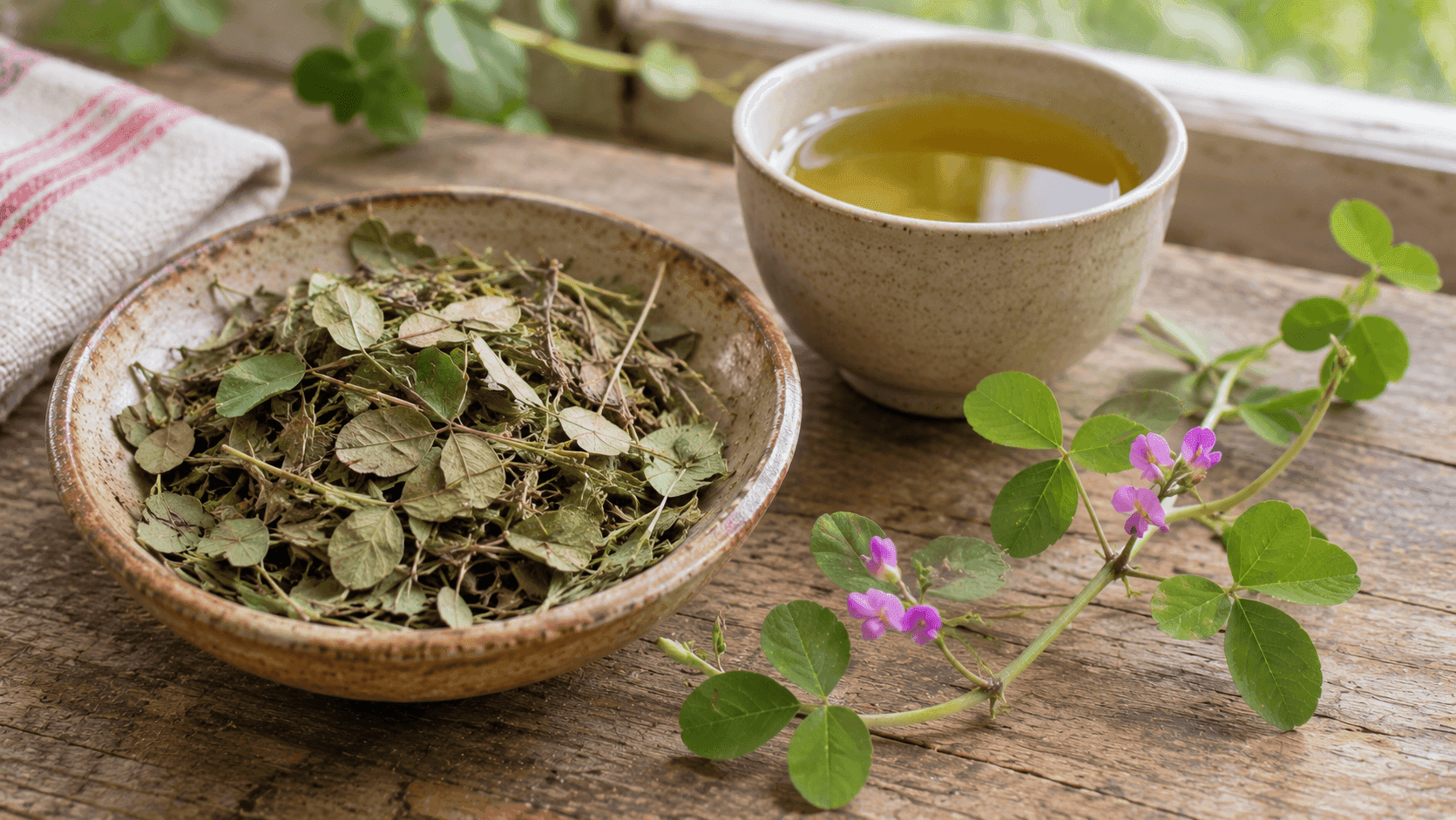
Desmodium (Grona adscendens, long called Desmodium adscendens) is a small perennial herb that creeps along the ground, with three-part leaves like clover and tiny hairy pods that cling to everything. In West Africa, its leaves are given as a drink, a remedy of tradition. Here, you mostly find it as a food supplement, and the French health authorities advise steering clear of those: read carefully what to know first.
His story
Desmodium is a small creeping plant from hot countries, from the same family as beans and clover. In West Africa it grows along the paths, and its leaves are given as a drink. Here, it has made a name for itself in the shops, and people often ask me about it. So I’ll tell you what I know, and also why it doesn’t come into my kitchen.
Desmodium: what kind of plant is it?
Its scientific name is Desmodium adscendens. In 2018 botanists moved it into another genus and now call it Grona adscendens, but in books and in shops everyone still says desmodium. It belongs to the Fabaceae, the family of beans, peas and clover.
It’s a perennial herb that creeps, or stands up a little, and can make a low little bush of just over a metre. Its leaves are made of three leaflets, like clover, and the one at the tip is a bit egg-shaped. Its flowers are tiny, in pairs along a spike, pink, bluish or pale mauve. Then come minuscule green, hairy pods, cut into three to six little segments, that stick to everything.
Those pods, in fact, are what it’s known for at the edge of the fields. They cling to animals’ fur and to people’s clothes, and that’s how the plant travels. The English call these plants “beggar lice”, because the seeds stay stuck to your shoes. I think the name suits them.
Where desmodium comes from: from African banks to American forests
Desmodium grows on its own in hot countries. You find it wild in tropical Africa down to southern Africa, on the islands of the western Indian Ocean, and on the other side of the Atlantic, from southern Mexico to the Amazon. The books say it first comes from West Africa, and it’s on that coast, as in Brazil and Peru, that people use it a lot.
It’s not a neat garden plant. It likes shade and damp: stream banks, the little dykes between rice fields, pastures, roadsides, and just about anywhere the soil has been turned over, like all weeds. Over there, it flowers and makes its pods all year round.
Herders like it too, for another reason: it’s good grazing for animals, especially in the dry season, when the rest of the grass is scorched. And since it enriches the soil, it’s sown in some tea and coffee plantations, between the rows, to cover the ground and make green manure.
In Ghana, among the Akan, it’s called akwamfanu or nkatenkate. In English it’s also nicknamed “sweetheart”. A weed called sweetheart, you have to admit it has some charm.
Desmodium benefits: what people did with it in West Africa
People often ask me about the benefits of desmodium. I’ll tell you what the serious books on West African plants report, just as it is, without promising you anything.
In Ghana, herbalists gave it as a drink to people whose chest felt tight and whose breath whistled. In Côte d’Ivoire, it was its leaves that were used for the same thing. The old collections of West African medicinal plants also mention it for colic, for coughs in Cameroon, and in Ghana to get a lazy tummy moving.
Over there, it’s taken by mouth, often as a decoction: the leaves are boiled in water, sometimes with the stems, and that water is drunk. People also drink the juice. The books give no safe amount, and I’m not going to make one up.
“Desmodium, I’ll tell you where it comes from. I won’t put it in your cup.”
If you’re struggling to breathe, if your chest whistles or feels tight, it’s not a plant you need: it’s your doctor. Me, I tell the traditions, I don’t stand in for anyone.
Here in France, desmodium has made its way into the shops: back in 2007 there were already some thirty products containing it, in phials or bottles. People credit it with all sorts of things. The French health authorities, for their part, wrote that no solid study showed the effects it’s credited with. I’d rather tell you straight.
Is desmodium dangerous? Why it doesn’t come into my kitchen
You may have read that desmodium is dangerous, or on the contrary that it’s perfectly gentle. The truth is that we don’t know enough. In 2007 the French health authorities looked into desmodium food supplements. They concluded that the plant, and its good or bad effects, were too poorly known to measure the risk. So they couldn’t say from what amount it would be safe, and they recommended avoiding it as a food supplement.
What had alerted them was the case of a person whose liver was affected while taking desmodium along with other products. No one can say how much was down to the plant. But that’s enough for me to be careful.
There’s something else. In products sold under the name “desmodium”, you can’t always be sure of the plant: a species from India, Desmodium gangeticum, can end up in its place. And in animals, researchers in Ghana saw that it could change the way the body clears other substances. If you take something on a doctor’s orders, that’s a real question to ask your doctor beforehand.
And desmodium isn’t on the list of medicinal plants of the French pharmacopoeia, and it has never been recognised as a medicinal plant. It isn’t a food over there either: in West Africa its leaves are a remedy of tradition, not a vegetable. So I don’t put it in my cup or in my soup.
A course of desmodium: how long? And for a bloated tummy, what I take instead
People also ask me how long a course of desmodium should last. I have no sure answer to give you: no one has ever set a safe amount or a safe length of time. The amounts you read on the products have never been shown to be safe. So I give you neither. If you already take some, or if you’re thinking about it, talk to your doctor or pharmacist, and show them the product.
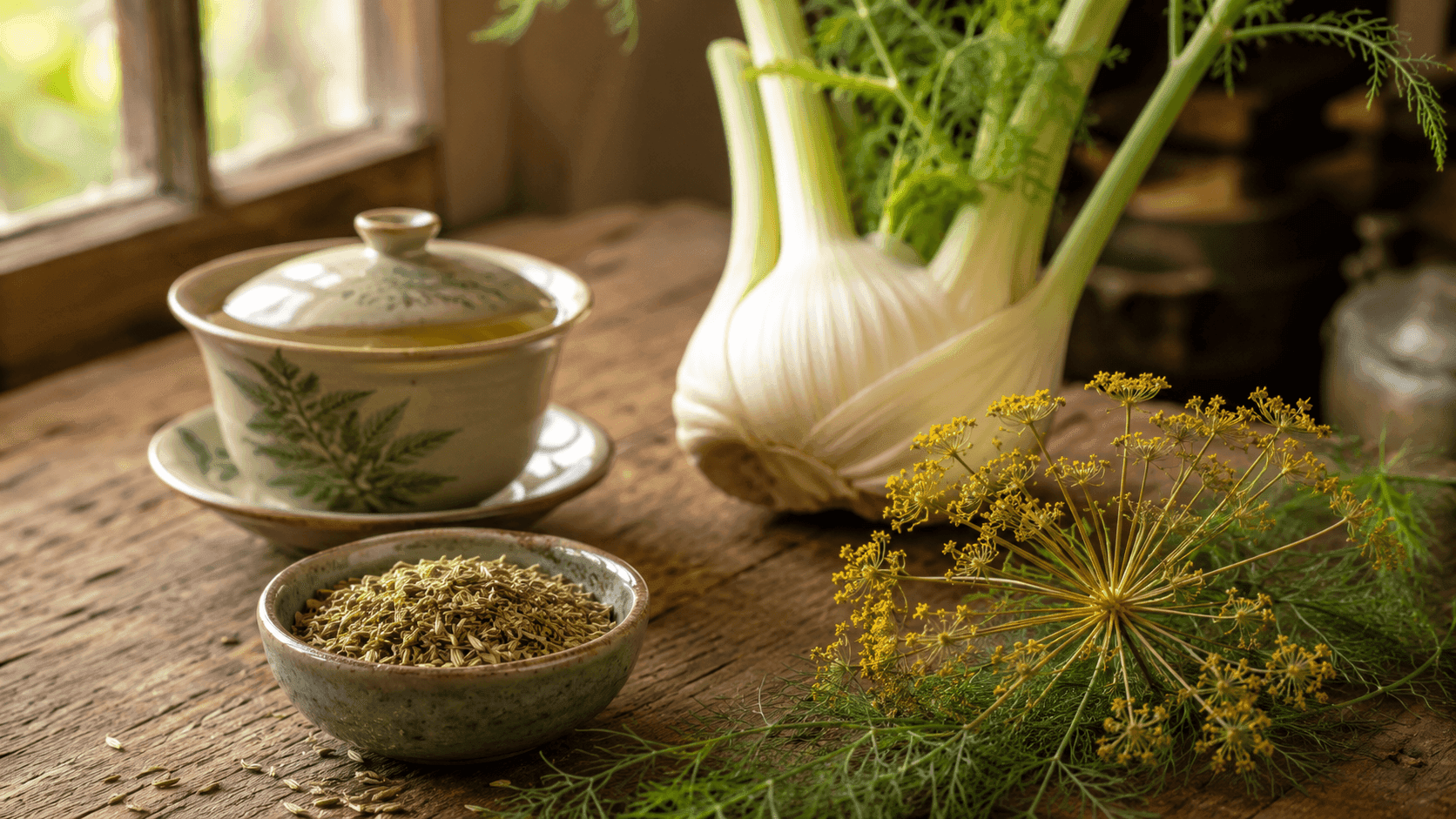
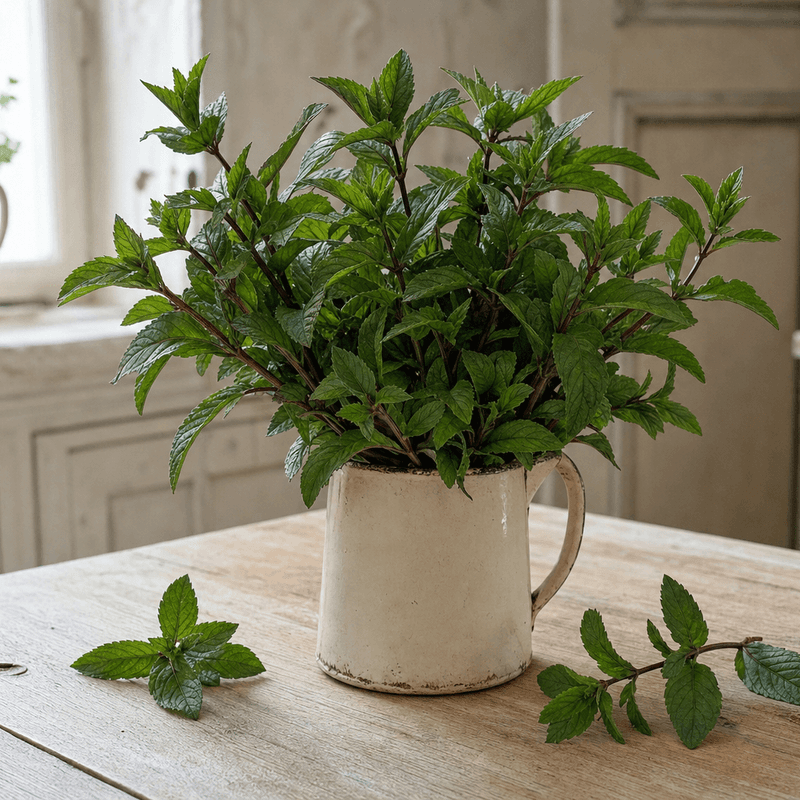
People sometimes mention desmodium to me for a bloated tummy after too rich a meal. For that, I have my old faithful plants, which the books know well and whose amounts we know. After a meal that bloats me, I make a tea from the seeds of my fennel, the one I introduced you to on its own page. When my stomach feels heavy, I go for the peppermint from my garden instead. My two cups are a little further down.
And if it’s your tummy that worries you, I’ve written down all my little habits for a bloated, tight tummy. If it really hurts, or if it goes on, go and see your doctor.
What people do with it, over there and here
- · 01In Ghana, herbalists gave it as a drink when the chest whistled and breath ran short.
- · 02In Côte d’Ivoire, it was its leaves that were used for the same thing.
- · 03The old West African collections also mention it for colic, for coughs in Cameroon and, in Ghana, to get a lazy tummy moving.
- · 04For animals and for the soil: good grazing in the dry season, and a ground cover between the rows of tea and coffee.
- · 05Here, you mostly find it as a food supplement, and the French health authorities advise steering clear of those. Me, I don’t use it.
How they prepare it over there
My cups in its place
For desmodium, I’m not giving you a recipe: nobody can say what amount is free of risk. For the days when your tummy bloats or your stomach feels heavy, here are my two old faithful cups instead.
Fennel tea for after a meal that bloats you
After lunch or dinner, when your tummy bloats and pulls
What you’ll need
- 1.5 g of dried fennel seeds (weigh them the first time, after that you’ll know by eye)
- 250 ml of water, a big bowl
How I go about it
- 01Bring the water to the boil.
- 02Put the seeds in the bottom of the bowl and pour the boiling water over them.
- 03Set a saucer on top and leave to steep for 15 minutes.
- 04Strain it and drink it hot, nice and slowly.
- 05Up to three bowls a day, no more than two weeks in a row, from age 12, and not during pregnancy or breastfeeding.
A cup of peppermint when your stomach feels heavy
After a meal, when digestion drags
What you’ll need
- 1.5 to 3 g of dried peppermint leaves (for an adult; 1 to 2 g from 4 to 17 years old)
- 150 ml of water
How I go about it
- 01Bring the water to the boil.
- 02Pour it over the leaves in the bottom of your cup.
- 03Cover and let it steep for 10 minutes, then strain.
- 04Sip it slowly. No more than three cups a day, not before age 4, not during pregnancy or breastfeeding, and not if you get heartburn. If it lasts more than two weeks, go and see your doctor.
What to know first
This information doesn’t replace advice from a healthcare professional. Health Disclaimer →
His identity card
- Name
- Desmodium
- Other names
- Akwamfanu, nkatenkate (Akan, Ghana), sweetheart
- Latin name
- Grona adscendens (Sw.) H.Ohashi & K.Ohashi (formerly Desmodium adscendens (Sw.) DC.)
- Family
- Fabaceae
- Part used
- The leaves, sometimes with the stems
- Harvest
- Flowers and makes its pods all year round in the tropics
- Form
- Leaves boiled or as juice in West Africa; food supplements in France
- Origin
- Tropical and southern Africa, western Indian Ocean, southern Mexico to tropical America
- Storage
- No sure advice in the books
If you remember just one thing
- 01Desmodium is a small creeping herb from the bean family, growing wild in the hot countries of Africa and America.
- 02In Ghana and Côte d’Ivoire, its leaves were given as a drink when the chest whistled and breath ran short.
- 03In France, the health authorities recommended back in 2007 avoiding desmodium as a food supplement: nobody can say what amount is free of risk.
- 04Desmodium is not on the list of medicinal plants of the French pharmacopoeia, and no safe amount has been set: I don’t give you one.
- 05If you take something on a doctor’s orders, if your liver or kidneys give you trouble, if you’re pregnant, breastfeeding, or it’s for a child: no desmodium without first talking to your doctor or pharmacist.
Your questions
It’s a small perennial, creeping herb from the bean family, Grona adscendens (long called Desmodium adscendens), with three-part leaves and tiny pods that stick to your clothes. It grows wild in hot countries: tropical Africa, the western Indian Ocean, and from southern Mexico to tropical America. The books say it first comes from West Africa, where its leaves are a remedy of tradition.
I’m not promising you anything, I’m telling you what people say. In Ghana and Côte d’Ivoire, its leaves were given as a drink when the chest whistled and breath ran short, and the old West African collections also mention it for colic and coughs. In France, the health authorities wrote that no solid study showed the effects it’s credited with.
We don’t know enough to call it free of risk. In 2007 the French health authorities concluded that no safe amount could be set, and they recommended avoiding desmodium food supplements. In animals, it also changed the way the body clears other substances: if you take something on a doctor’s orders, talk to your doctor or pharmacist first.
No one can say, one way or the other. In France, liver damage was reported in a person who was taking desmodium supplements with other products, and no one knows how much was down to the plant. The health authorities concluded that its effects were too poorly known to set an amount free of risk. If your liver already gives you trouble, it’s your doctor you need to see, not a plant.
No one has ever set a safe length of time or a safe amount, so I don’t give you one. The amounts you read on the products have never been shown to be safe. If you already take some, show the product to your doctor or pharmacist.
The books give no sure data for these times. So before anything else, ask your doctor or pharmacist. And remember that the authorities have already recommended that everyone avoid desmodium supplements.
References
- Avis relatif à l'emploi dans les compléments alimentaires de plantes ayant fait l'objet de signalements de pharmacovigilance (saisine 2007-SA-0171) · Afssa (aujourd'hui Anses), copie archivée, 2007
- Liste A des plantes médicinales utilisées traditionnellement, Pharmacopée française janvier 2026 · ANSM, 2026
- Liste B des plantes médicinales utilisées traditionnellement, Pharmacopée française janvier 2026 · ANSM, 2026
- Grona adscendens (Sw.) H.Ohashi & K.Ohashi · Plants of the World Online, Royal Botanic Gardens, Kew, 2026
- Desmodium adscendens, Agroforestree Database 4.0 · World Agroforestry (ICRAF), 2009
- Effects of the extracts of Desmodium adscendens on anaphylaxis · Journal of Ethnopharmacology (PubMed 6482479), 1984
- Tracheal relaxation of five Ivorian anti-asthmatic plants · Journal of Ethnopharmacology (PubMed 21963567), 2011
- Ethnobotanical Plant: Desmodium adscendens · Dr. Duke's Phytochemical and Ethnobotanical Databases, USDA, 2026
- Acute and Subchronic Toxicity Studies of Aqueous Extract of Desmodium adscendens (Sw) DC · Journal of Evidence-Based Complementary & Alternative Medicine (PubMed 29228815), 2017
- Safety of Desmodium adscendens extract on hepatocytes and renal cells · Journal of Intercultural Ethnopharmacology (PMC4566765), 2015
- Antinociceptive effects of an ethanolic extract of Desmodium adscendens · Health Sciences Investigations Journal, University of Ghana, 2020
- In vitro gastrointestinal biotransformation and characterization of a Desmodium adscendens decoction · Journal of Pharmacy and Pharmacology (PubMed 30003542), 2018
- Desmodium · Wikipedia, 2026
- European Union herbal monograph on Foeniculum vulgare Miller subsp. vulgare var. vulgare, fructus (Rev. 1) · European Medicines Agency (HMPC)
- European Union herbal monograph on Mentha x piperita L., folium (Rev. 1) · European Medicines Agency (HMPC)
- Desmodium adscendens (Sw.) DC., synonyme de Grona adscendens (Sw.) H.Ohashi & K.Ohashi (World Checklist of Vascular Plants, base de POWO) · Royal Botanic Gardens, Kew, via GBIF, 2026