Comfort for a lazy tummy
Grandma’s remedies for constipation: drink plenty, add fiber little by little, move a bit every day and take some flaxseed. And know when it’s time to see your doctor.
Reviewed by Ruosi Wu, PhD in Pharmacy, MD in Traditional Chinese Medicine
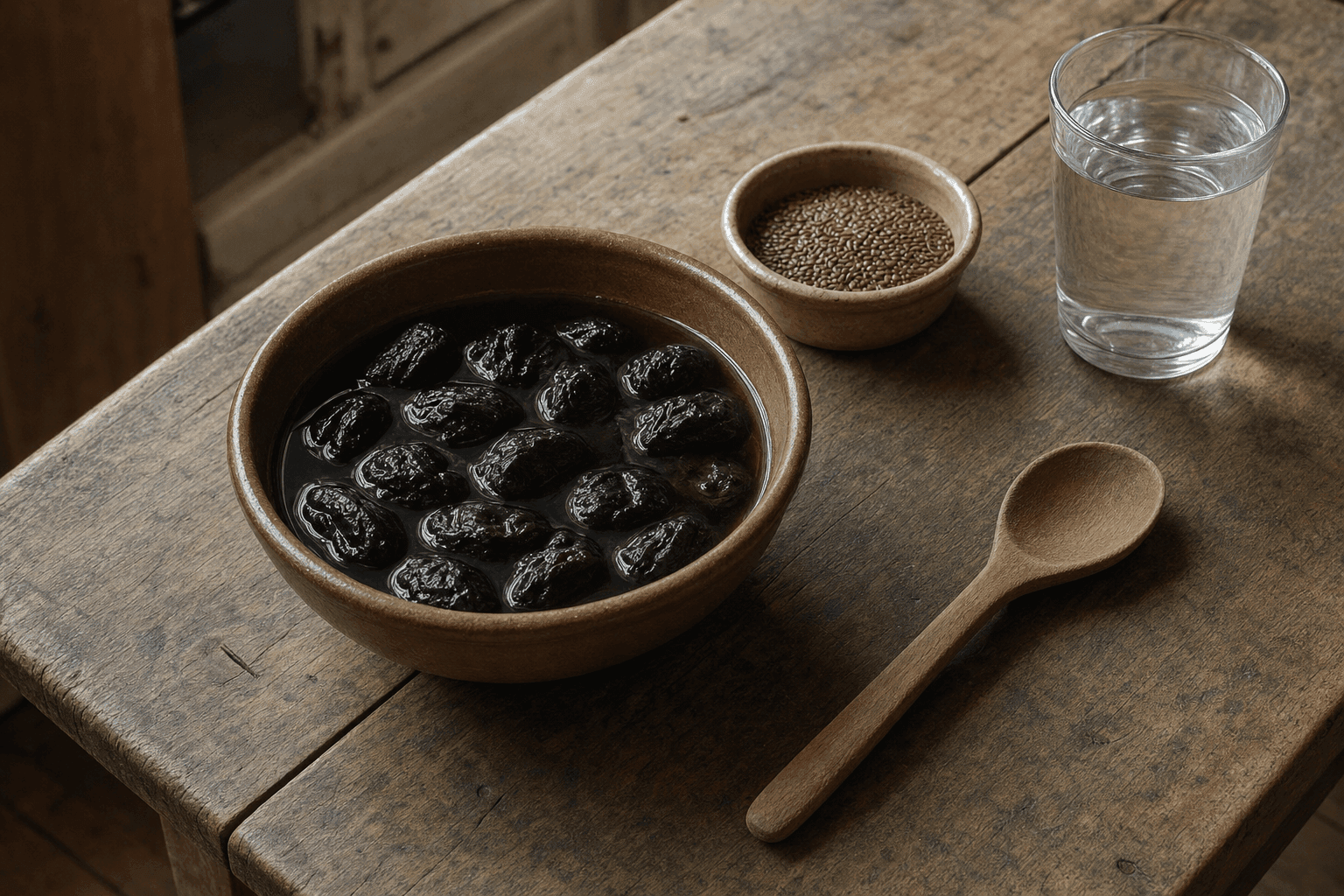
For constipation and slow bowels, my grandma’s remedy starts with water: at least a liter and a half a day. Then add fiber little by little and move a bit every day. Flaxseed is what my books give for everyday constipation, and fennel seeds for a bloated tummy. If you’re vomiting and nothing passes, or if there’s blood or a fever, go and see your doctor.
Key takeaways
- Lazy bowels means fewer than three stools a week, hard and difficult to get out, often with cramps and a swollen tummy.
- For slow bowels, the basics are drinking at least a liter and a half a day and adding fiber little by little, over two weeks.
- Moving at least five days out of seven, going to the toilet at a set time and never ignoring the urge: that helps a lazy bowel.
- Flaxseed, 10 to 15 g with a big glass of water two to three times a day, is what my books give for everyday constipation.
- Vomiting with a tummy that won’t let any gas through means calling 15 (the emergency number in France); blood in your stools or a fever means seeing the doctor the same day.
Granny’s little steps
- Drink a liter and a half a day
Water mostly, and waters rich in magnesium help you go. Soup, herbal teas and fruit juice count too; coffee, tea and fizzy drinks, without overdoing it.
- Add fiber little by little
Vegetables, fruit, beans and lentils, wholegrain bread, prunes, nuts: go up gently over two weeks, or your tummy bloats and pulls.
- Move at least five days out of seven
A walk, the garden, an easy bike ride, every day if you can. And drink during and after.
- Go to the toilet at a set time
Half an hour to an hour after a meal, and as soon as you feel the urge, without ignoring it. Take your time, without pushing hard.
- A footstool under your feet
A little stool or a cushion, so your feet are level with the toilet bowl. It helps things come down.
A recipe to try
The breakfast flaxseed
In the morning at breakfast, and once or twice more during the day
What you’ll need
- 10 to 15 g of flaxseed (weigh it the first time, after that you’ll know by eye)
- 150 ml of water, milk or fruit juice, a big glass
- Water to drink through the morning
How I go about it
- Weigh out 10 to 15 g of flaxseed.
- Take it with the big 150 ml glass of water, milk or fruit juice, and drink the whole glass.
- Drink more water through the morning: without enough to drink, the seeds swell and can block things up instead of helping.
- Leave half an hour to an hour between it and anything you take on a doctor’s orders.
- You can have it again at lunch and at your afternoon snack, two to three times a day in all, but not just before you go to bed.
- Count on 12 to 24 hours before it works, sometimes two or three days. If nothing has moved after three days, ask your doctor or your pharmacist. Not before age 12.
Slow bowels and gas get going again first with water, fiber added little by little and moving about, not with a tea that forces your tummy. I’ll tell you what I do when my bowels get lazy, what my books say, and when it’s time to go and see your doctor.
Slow bowels and gas: where lazy bowels come from
A lazy bowel is what the books call constipation. They talk about it when you go fewer than three times a week, with hard stools that are difficult to get out. Some people go twice a week without any trouble at all: what counts is your own rhythm.
Most of the time, there isn’t one single cause, but lots of little things added up. Not enough fiber on your plate. Not enough to drink. Too many hours sitting down. A trip, a change in your habits, a few days in bed. Stress, too. And the urge you let pass because it’s not the right moment: after a while, your tummy stops insisting. Some things you take on a doctor’s orders play a part too: for pain, for low spirits, to make you pee or for stomach acid.
After sixty, it happens more often. During pregnancy too: roughly one pregnant woman in two.
And the gas in all this? Passing gas is normal, it’s part of digestion. But bowels that drag often come with cramps and bloating: you feel swollen, tight, heavy. And when you start on fiber all at once, your tummy bloats even more.
What to do at home when your bowels are lazy
First, I drink. At least a liter and a half through the day, unless your doctor has told you otherwise. Soup, herbal teas and fruit juice count too. Coffee, tea and fizzy drinks, don’t overdo them. Mineral waters rich in magnesium help you go. Me, I start the day with a big glass of water before my coffee.
Next, your plate. The books reckon on about 25 grams of fiber a day: vegetables, fruit, beans and lentils, wholegrain bread and cereals, dried fruit like prunes, walnuts and almonds. But you go up little by little, over two weeks, or your tummy bloats and pulls. Very fatty and very sweet dishes, I keep for Sundays.
Then you move. At least five days out of seven, and every day if you can. Walking is very good, so is the garden, and remember to drink during and after. Sitting for hours on end, your tummy doesn’t like that one bit.
Last, the toilet. Go at a set time, half an hour to an hour after a meal: after breakfast, for example. When the urge comes, don’t wait. Take your time, without pushing hard: over time, that can make hemorrhoids or a small tear worse. And put your feet on a little footstool, or a cushion, so they’re level with the toilet bowl. My grandson made fun of my stool. He uses it all the same.
When my bloated tummy pulls, I get out the hot-water bottle, nice and hot, not scalding, wrapped in a tea towel. It doesn’t make the bloating go down. But the warmth helps it hurt less, and that’s something.
Grandma’s natural remedies for lazy bowels
For the bowels themselves, my books don’t give a magic tea. They give seeds. And for the gas that comes along with it, two plants I always keep on hand.
Flaxseed. This is what the pharmacopoeia gives for everyday constipation, when you need softer stools. You take 10 to 15 grams with a big 150 ml glass of water, milk or fruit juice, two to three times a day, from age 12. And you keep drinking well afterwards: without enough water, the seeds swell where they shouldn’t. Not just before bed. They don’t work straight away: count on 12 to 24 hours, sometimes two or three days. At first, they often give you a bit of gas. If nothing has moved after three days, ask your doctor or your pharmacist.
Prunes. They’re on the list of dried fruit the books give for fiber. At my house, there’s always a jar of them on the shelf, and I put a few on the breakfast table.
Fennel seeds, for gas. Not to make you go: for the bloated tummy that pulls after eating. You count 1.5 grams of seeds for a big bowl of boiling water (250 ml), fifteen minutes covered, up to three bowls a day, no more than two weeks in a row, and from age 12. Everything I know about fennel, I tell you over here.
Peppermint. That one’s for when digestion drags and your tummy makes gas. For an adult, 1.5 to 3 grams of dried leaves in 100 to 150 ml of boiling water, ten minutes covered, three cups a day at most. If you get heartburn, leave it aside, it can make it worse. I tell you about my peppermint here.
What I don’t give you: the “bowel” teas with senna, cascara or aloe. They make you go by force, and the books advise against them: taken often, they throw your rhythm off, your bowel gets used to them and becomes even lazier. And hibiscus, which you see in some blends? I love it iced in summer, but my books don’t give it for the bowels, and in some people, it even constipates a little.
If it’s mostly the bloated tummy that bothers you, I have other little habits for bloating. And for meals that sit heavy on your stomach, it’s this way.
“You don’t rush a lazy bowel. You get it going again with water, fiber and a little patience.”
Slow bowels and gas: knowing when it’s no longer a small trouble
Bowels that drag after a trip happen to everyone. But some signs don’t wait. Vomiting, tummy pain and no gas coming out at all: then you call 15 (the emergency number in France) right away. Blood in your stools, a fever, a very swollen tummy that won’t let anything through: you see your doctor the same day. And if you’re past 50 and your bowels suddenly started dragging, for no reason, don’t wait for it to pass on its own.
I’ve put the full list just below, sign by sign. And if your bowels stay lazy despite water, fiber and walking, your doctor has other solutions: that’s their job.
What to know first
Flaxseed: not before age 12, and not during pregnancy or breastfeeding, as there isn’t enough data. No flaxseed if you have trouble swallowing or a throat problem. No flaxseed either if your bowel habits changed suddenly and it’s been going on for more than two weeks, if you’re bleeding from the back passage without knowing why, or if nothing passes despite a laxative: in those cases, it’s your doctor. Nor if your bowel is narrowed or blocked, if your bowel is paralyzed, if your colon is very swollen, or if you have a disease of the esophagus.
Flaxseed, always with enough water: taken without enough to drink, it can swell and block the throat, the esophagus or the bowel. If after taking it you have chest pain, you vomit, or you find it hard to swallow or breathe, see a doctor right away. If your tummy hurts or your bowel movements become irregular, stop and ask for advice. Gas is common at first; allergies are very rare.
Flaxseed and other treatments: it can slow down how your body takes in what you take at the same time. Leave half an hour to an hour between it and your medications. If you take opioids for pain or loperamide for diarrhea, no flaxseed without your doctor’s advice. For an elderly or frail person, take it with someone keeping an eye. Taken for a long time, flaxseed might act a little like a female hormone: if you have or have had a hormone-dependent tumor, no flaxseed over the long term.
Fennel: not during pregnancy or breastfeeding. No fennel tea before age 4. Between 4 and 12, the books give a smaller cup (1 g of seeds in 100 ml of boiling water, 15 minutes, up to three times a day, for less than a week), but only with seeds known to be suitable for children: ask your pharmacist first. No fennel if you’re allergic to fennel, anethole, anise, caraway, celery, coriander, dill or mugwort pollen. No more than two weeks in a row.
Peppermint: not during pregnancy or breastfeeding, and not before age 4. From 4 to 17, 1 to 2 g of leaves per cup, three times a day at most. If you have heartburn or acid reflux, avoid it, it can make them worse. If you have gallstones or another bile problem, ask your doctor first. No peppermint if you’re allergic to peppermint or menthol. If it’s no better after two weeks, or if it gets worse, see your doctor.
Senna, cascara or aloe teas: these are laxatives that force the bowel, and they’re not recommended: taken regularly, they throw your rhythm off, your bowel gets used to them, and the constipation gets worse, even when they’re plant-based. For all laxatives: never for long without your doctor’s advice, never more than the stated dose, and never two at once or one after the other without medical advice. Oily (lubricant) laxatives should be avoided if things tend to go down the wrong way when you swallow, especially in older people: they can get into the lungs.
Pregnancy and children: if you’re pregnant and constipated, don’t take anything without your doctor’s advice, plants included. Here, I’m talking about grown-ups: for a constipated child, ask their doctor.
For fennel and peppermint, the books don’t report any interaction with a treatment. If you already take something on a doctor’s orders, still ask your pharmacist before drinking it regularly.
When to see your doctor
- You’re vomiting, your tummy hurts and no gas comes out at all: call 15 or 112 (the emergency numbers in France) without delay.
- Fever with severe pain in your tummy: see your doctor the same day.
- Fever or chills along with constipation: see your doctor the same day.
- Blood in your stools: see your doctor the same day.
- Tummy pain that won’t go away, nausea or vomiting along with constipation: see your doctor the same day.
- No more gas coming out, with a very swollen tummy: see your doctor the same day.
- You’re over 50 and the constipation came on recently, and was severe right from the start: see your regular doctor in the next few days.
- You’ve never been constipated and it comes on for no obvious reason, or an unusual bout of constipation lasts more than two or three days: see your doctor in the next few days.
- Mucus in your stools: see your doctor in the next few days.
- Bouts of diarrhea alternating with constipation: see your doctor in the next few days.
- You can no longer hold in your stools: see your doctor in the next few days.
- You’re losing weight without trying: see your doctor in the next few days.
- The constipation started with a new treatment, or you take medication that constipates: talk to your regular doctor in the next few days.
- You’re pregnant or breastfeeding and constipated: talk to your regular doctor, and don’t take anything without their advice.
- You have a long-term condition of the colon or kidneys, diabetes or Parkinson’s disease, and constipation is setting in: see your regular doctor in the next few days.
- Your bowels stay lazy despite water, fiber and moving: see your regular doctor in the next few days.
Your questions
How can I help slow bowels?
Drink at least a liter and a half a day, counting water, soup and herbal teas. Add fiber little by little over two weeks: vegetables, fruit, beans and lentils, wholegrain bread, prunes. Move at least five days out of seven, go to the toilet at a set time after a meal, and never ignore the urge.
Slow bowels and gas: why do they go together?
Passing gas is normal, it’s part of digestion. But bowels that drag often come with cramps and a bloated tummy. And if you start on fiber or flaxseed all at once, your tummy bloats even more: that’s why you go up gently. For the gas, a cup of fennel seed or peppermint tea is what my books give.
What are the symptoms of a lazy bowel?
You go fewer than three times a week, your stools are hard and difficult to get out. Often your tummy is uncomfortable, with cramps and bloating. When it lasts more than six months, it’s called chronic constipation, and that’s something to show your doctor.
What’s a natural remedy for a lazy bowel?
Flaxseed: 10 to 15 g with a big 150 ml glass of water, milk or fruit juice, two to three times a day, from age 12, and you drink plenty afterwards. Count on 12 to 24 hours, sometimes two or three days. Prunes and other fiber help too. Teas with senna, cascara or aloe, I don’t recommend them.
What should I drink when I’m constipated?
Water first, at least a liter and a half a day, and waters rich in magnesium help you go. Herbal teas, soup and fruit juice count too. Coffee, tea and fizzy drinks, don’t overdo them.
Gas that won’t come out anymore: is it serious?
It can be. If you’re vomiting, your tummy hurts and no gas comes out at all, call 15 or 112 (the emergency numbers in France) without delay. If nothing passes and your tummy is very swollen, or if there’s fever or blood in your stools, see your doctor the same day.
References
- Constipation de l'adulte : que faire et quand consulter ? · ameli.fr, 2025
- Constipation de l'adulte : définition, symptômes, facteurs favorisants · ameli.fr, 2025
- Constipation de l'adulte · Santé.fr, 2026
- European Union herbal monograph on Linum usitatissimum L., semen · EMA, HMPC, 2015
- European Union herbal monograph on Foeniculum vulgare Miller subsp. vulgare var. vulgare, fructus (Rev. 1) · EMA, HMPC, 2024
- European Union herbal monograph on Mentha x piperita L., folium (Rev. 1) · EMA, HMPC, 2020
- Ceintures, bouillottes, gaines : quels objets utiliser contre les ballonnements ? · Allodocteurs, France Télévisions, 2024
- Hibiscus Sabdariffa: Uses, Side Effects, and More · WebMD
Information. This information is provided for general knowledge and doesn’t replace medical advice. Check with a healthcare professional before any use.
Health Disclaimer