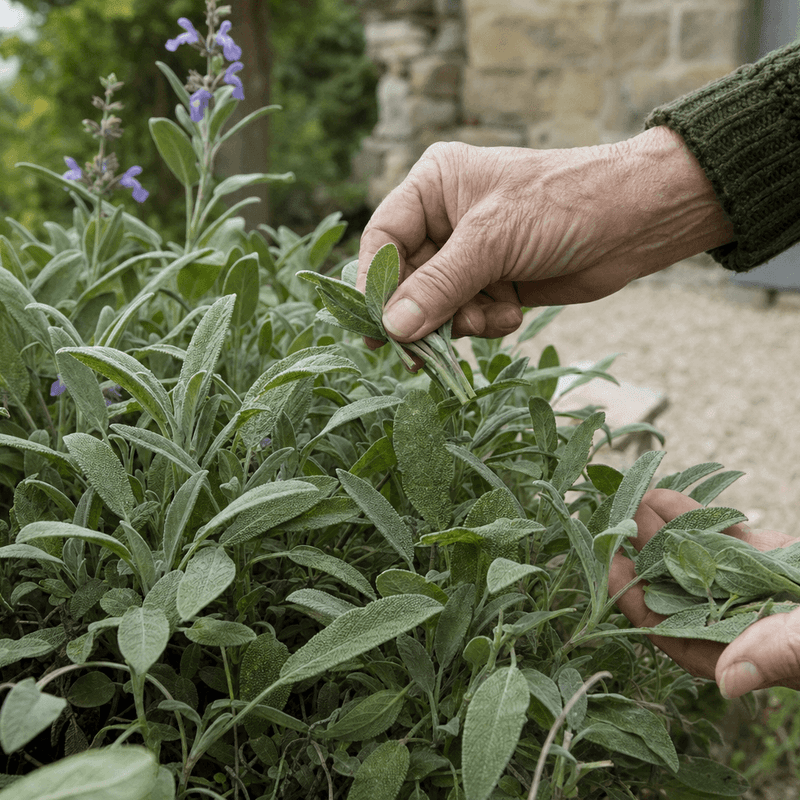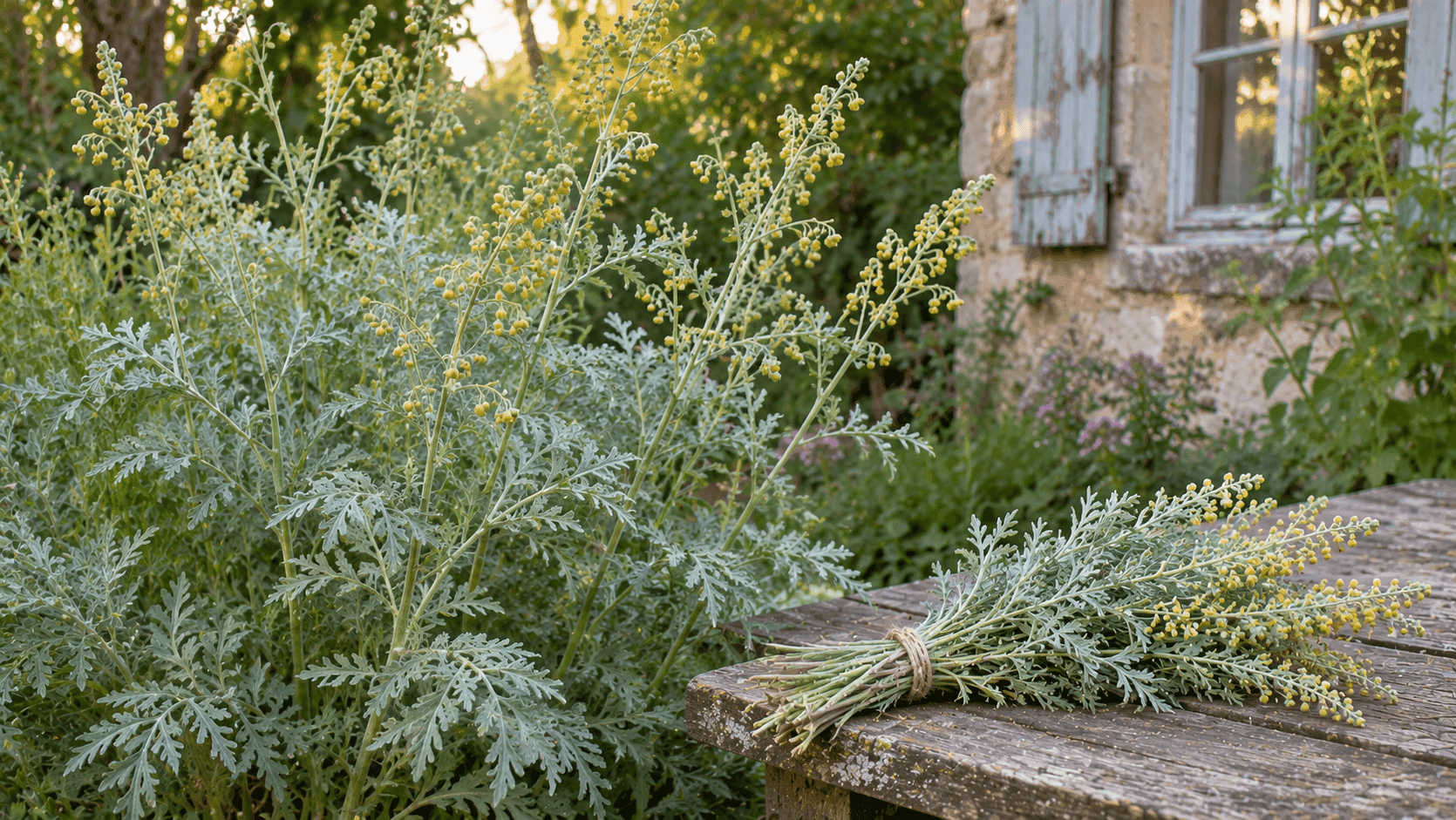
Wormwood is a silvery, very bitter perennial herb, a cousin of mugwort. I drink it rarely, in a very small cup before a meal, and I respect its limits.
Who she really is
Family: Daisy family (Asteraceae). It grows wild from Europe to Siberia and the western Himalaya, and in North Africa, on dry ground and along paths.
Part used: the leaves and flowering tops, dried.
Wormwood is a perennial plant with silvery grey foliage, covered in silky hairs, with a bitterness you don't forget. It's best known for the drink that carries its French name, absinthe, but first and foremost it's a garden herb. Me, I drink it rarely, a very small cup before a meal, and the rest of the time I watch it shine at the edge of the vegetable patch.
Her story
The wormwood plant, the one the French call absinthe, is grand wormwood, Artemisia absinthium: a perennial herb, grey as ash in the sun, and bitter like nothing else. Everyone knows it from the drink that carries its name. Me, I know it from the garden: I have a clump at the edge of the vegetable patch, and I look at it far more often than I drink it.
Wormwood, what kind of plant is it exactly?
It belongs to the daisy family, the Asteraceae, the same as mugwort and tarragon. It makes a clump 50 centimetres to 1 metre tall, almost a little shrub. Everything about it is covered in tiny silky hairs, silvery white: the stems, upright and grooved, and the leaves, deeply cut, grey-green on top and nearly white underneath. Crush one between your fingers: the smell is strong. And if you're unlucky enough to chew on one, you'll remember it until evening.
From July to September, it covers itself in little yellow flowers, in nodding balls, packed in clusters at the tips of the stems. In the wild, it grows from Europe to Siberia and the western Himalaya, and in North Africa: on dry, uncultivated ground, stony slopes, along paths and field edges.
It's been given heaps of names: grand wormwood, bitter mugwort, and in French alvine, aluine, holy herb, worm herb. Its learned name, Artemisia, comes from Artemis, the Greek goddess of the hunt. And "little wormwood" is a cousin, Artemisia pontica, a slighter plant.
The old books say its powder was once mixed into the copyists' ink, so insects wouldn't eat the manuscripts. And in Shakespeare, Juliet's nurse says she rubbed wormwood on her breast to wean the little one. With a bitterness like that, I can well believe it worked.
Wormwood or mugwort: the difference, and where tarragon fits in
People often ask me the difference between wormwood and mugwort. They're cousins, in the same genus, Artemisia. But they don't look that much alike. Common mugwort, Artemisia vulgaris, is taller, from 60 centimetres to 2 metres, with dark green foliage and stems that are often reddish purple. Wormwood is all grey and silvery, and much more bitter. What fools people is the smell: crushed, their leaves smell roughly the same.
Tarragon, Artemisia dracunculus, is something else again: narrow, smooth, shiny, dark green leaves that smell of aniseed. That one goes in the sauce and on the chicken. Wormwood, I never put in my cooking.
And careful: mugwort also contains the substance that makes wormwood dangerous in large amounts, the one the books call thujone. Switching cousins doesn't mean you can take more.
What the old books say about wormwood
I'll tell you things as they are. Wormwood is a bitter plant, and it's always been drunk for that. In the old days, people took it as a powder, as an infusion, sometimes in wine: against worms, for the stomach, for digestion, against seasickness.
Today the pharmacopoeia has kept only two uses, and that's already a lot for a plant like this: when your appetite lags for a while, and when digestion is sluggish, with that heavy feeling. It's a traditional use, based on long habit, not a promise. All you read elsewhere about the thousand benefits of wormwood, I won't repeat: the serious books say it rests on tradition, nothing more.
How do you take it? In a very small cup. The books give 1 to 1.5 g of the cut dried plant in 150 ml of boiling water, and no more than 2 to 3 g over the day: two cups at most. For the appetite, you drink it half an hour before the meal; for digestion, after. I weigh it on my kitchen scales, because one gram, by eye, is easy to get wrong. And it's for grown-ups only: not before 18.
It's bitter, very bitter, and that's how it is. If you want to understand why some herbal teas are so bitter, I wrote you a letter about it. And if it's mostly the evening meal sitting heavy, I have other, gentler habits for a sluggish digestion.
Me, I only take it for a few days, when my appetite lags. And the books are clear: if after two weeks things aren't better, or if they get worse, you stop and go see the doctor. The wormwood for my cup, I don't pick in the garden: I ask the village pharmacist for it. The amount of thujone varies from one plant to another, and the books want it known. Read what you need to know first, further down: with this plant, it's not a formality.
From the green fairy to the ban: wormwood, the plant and the drink
Now, the drink, since that's what I'm asked about most. The absinthe you drink in a bar is a spirit made with plants: grand wormwood, green anise and fennel. It was born at the end of the 18th century in the Val-de-Travers, in Switzerland. The first distillery opened in Couvet, and in 1805 Henri-Louis Pernod set up his own in Pontarlier, in the Doubs. Pontarlier became its capital: around 1900, the little town had 25 distilleries and 3,000 workers.
In the 19th century, it was all the rage. People called it the "green fairy", and in 1870 it made up 90% of the aperitifs drunk in France.
Why was absinthe banned? It was accused of driving people mad, and thujone took the blame. But the texts of the time say it plainly: the aim was first of all to fight alcoholism. It was a very strong drink, 68 to 72 degrees in the bottle, and cheap, poor-quality absinthes were flooding the cafés. Switzerland banned it in 1910, France in 1915.
It came back little by little. In 1988, a decree set limits on thujone in drinks, and it could be made again, under the name "spirit flavoured with the absinthe plant". Switzerland allowed it again in 2005, and in France, the old 1915 law was repealed in May 2011. The amount of thujone in these drinks is still limited by law. Today, the books say you can't pin everything on the plant: to swallow a dangerous dose of thujone from the drink, you'd have to drink several litres, and the alcohol would have done its damage long before.
Today it runs between 45 and 90 degrees, depending on the bottle. I'm telling you all this because it's part of its story, not to tempt you. It isn't a herbal tea, it's a strong spirit, and in my house we don't serve it.
Wormwood in the garden: where to plant it, how to take cuttings
In the garden, wormwood is easy to live with. It wants full sun and soil that drains well, chalky, loamy or sandy. It dreads standing water much more than poor soil, and in heavy, waterlogged ground it dies back. As for cold, it holds out down to -15 or -20 °C.
To get more plants, the simplest way is to divide an old clump in spring, or at the start of autumn where winters are mild. You can also sow it, under 1 to 2 cm of fine compost. And for cuttings, it's early summer: you take the tips of stems that are still soft, or little side shoots with a heel, and root them.
In spring, I cut it back to the young shoots at the bottom, and after flowering, a light trim keeps it nice and round. It has a temper, though: its roots bother the plants around it. So I never put it in among the vegetables, always along the edge.
It's also said to keep little creatures away. People make a plant brew from it to spray, and they say it drives off aphids, cabbage white butterflies or flea beetles; in the old days, dried bunches were hung up to keep insects away. I promise you nothing, I do as my mother did, and the recipe is further down. But the brew is for the plants: it's not for drinking, and you store it up high.
What I use her for
- · 01In a very small bitter cup, half an hour before a meal, when your appetite lags: 1 to 1.5 g of dried plant in 150 ml of boiling water.
- · 02The same small cup after a meal that was too heavy, two cups a day at most, and if things aren't better after two weeks, I go see the doctor.
- · 03As a plant brew in the garden, diluted and sprayed in the evening: they say it keeps aphids, slugs and cabbage whites away.
- · 04As a dried bunch, like in the old days, to keep little creatures away.
- · 05Along the edge of the vegetable patch, for its silver foliage, never in among the vegetables.
How I prepare her
Granny’s little recipes
The little bitter cup before a meal
Half an hour before a meal, when your appetite lags (adults only)
What you’ll need
- 1 to 1.5 g of cut dried wormwood (leaves and flowering tops), weighed on the scales
- 150 ml of water
How I go about it
- 01Bring the water to the boil and pour it over the plant, in your cup.
- 02Cover and leave to steep for 10 minutes, then strain.
- 03Drink it half an hour before the meal. On days when it's digestion that's sluggish, the books give it after the meal instead.
- 04No more than two cups in a day (2 to 3 g of plant in all). If things aren't better after two weeks, or if they get worse, stop and go see your doctor.
Wormwood brew for the garden
In the garden, from July to October (10 to 15 days of steeping)
What you’ll need
- About 1 kg of fresh wormwood leaves and flowers
- About 10 litres of water, rainwater if possible
- A plastic bucket (not metal) and an old cloth
How I go about it
- 01Cut the stems with secateurs and put them in the bucket without chopping them.
- 02Cover with water, lay the cloth over the bucket to let the gases out, and leave it outside, in the shade.
- 03Stir for 5 to 10 minutes every day with a wooden stick, for 10 to 15 days, until there are no more bubbles or white foam.
- 04Strain through gauze, pour into an opaque container, write on it what it is and store it up high: it's not for drinking.
- 05To spray, dilute it to 10% (1 litre of brew to 9 litres of water), preferably in the evening, with no rain or wind, never in full sun or on thirsty plants.
Elsewhere: how others know her
Fatima, my friend in Marrakech, taught me that where she lives, wormwood is called chiba (شيبة), and also chadjret maryem. There, it doesn't end up in a glass of spirits: it goes in the tea. As soon as the cold comes, especially in October, they put chiba in the teapot instead of mint, because mint is for the summer heat. I told you about her tray of mint tea in a letter.
Keiko, my friend in Tokyo, wrote to me that where she lives, they call it nigayomogi, "bitter mugwort", plain and simple. It only reached Japan at the end of the Edo period.
Me, what I love is simpler: my silvery wormwood at the edge of the vegetable patch, shining after the rain. Chiba tea, I leave to Fatima. In my house, wormwood is a small weighed cup, now and then, and that's all.
What to know first
This information doesn’t replace advice from a healthcare professional. Health Disclaimer →
Her identity card
- Name
- Wormwood
- Other names
- Grand wormwood, absinthe, bitter mugwort, chiba
- Latin name
- Artemisia absinthium L.
- Family
- Daisy family (Asteraceae)
- Part used
- Leaves and flowering tops
- Harvest
- Flowers from July to September
- Form
- Infusion of the dried plant; plant brew in the garden
- Origin
- From Europe to Siberia and the western Himalaya; North Africa
- Storage
- Dried, in a closed jar, away from light and heat
If you remember just one thing
- 01The wormwood plant is grand wormwood, Artemisia absinthium: a silvery, very bitter perennial herb, a cousin of mugwort and tarragon.
- 02The books give it in a very small cup: 1 to 1.5 g in 150 ml of boiling water, 2 to 3 g a day at most, for adults; if things aren't better after two weeks, you see the doctor.
- 03What makes it dangerous in large amounts is thujone: never the essential oil, and no wormwood when pregnant, breastfeeding or before 18.
- 04The drink absinthe was banned in France in 1915, and that law was repealed in 2011: it's a story about a strong spirit, not a reason to drink it.
- 05In the garden, it wants sun and soil that drains, and you plant it along the edge, because its roots bother its neighbours.
Your questions
I promise you nothing. The pharmacopoeia has kept two traditional uses: when your appetite lags for a while, and when digestion is sluggish, with a heavy feeling. You take it in a very small cup, 1 to 1.5 g of the dried plant in 150 ml of boiling water, no more than two cups a day, and only from age 18. If things aren't better after two weeks, go see your doctor.
Yes, in large amounts. It contains thujone, which can cause vomiting, dizziness and even convulsions if you take too much. That's why you stick to the dose, never touch the essential oil, and go without it when pregnant, breastfeeding and before 18. Read the ‘What to know first’ part carefully.
They're two cousins in the same genus, Artemisia. Wormwood is silvery grey, covered in silky hairs, and very bitter; common mugwort is taller, dark green, with stems that are often reddish purple. Tarragon, a third cousin, has smooth leaves that smell of aniseed and goes in the kitchen. Mugwort also contains thujone: don't take it lightly either.
The drink absinthe was banned in Switzerland in 1910 and in France in 1915. It was accused of driving people mad, but above all the aim was to fight alcoholism: it was a very strong drink, drunk in quantity. It came back little by little with a limit on thujone, and in France, the 1915 law was repealed in May 2011.
In early summer, take the tips of stems that are still soft, or little side shoots with a heel, and root them. Even simpler: divide an old clump in spring, or at the start of autumn where winters are mild. Then plant it in the sun, in soil that drains well, along the edge of the vegetable patch.
Chiba is the name given to wormwood, Artemisia absinthium, in North Africa; in Moroccan Arabic, it's written شيبة. In Morocco, people put it in their tea when the cold comes, instead of mint. It's the same plant as here, with the same thujone: the same precautions apply.
References
- European Union herbal monograph on Artemisia absinthium L., herba (EMA/HMPC/751490/2016 Corr. 1) · European Medicines Agency (HMPC), 2020
- Community herbal monograph on Artemisia absinthium L., herba, first version (EMEA/HMPC/234463/2008), superseded · European Medicines Agency (HMPC), 2009
- Public statement on the use of herbal medicinal products containing thujone (EMA/HMPC/732886/2010 Rev.1) · European Medicines Agency (HMPC), 2012
- Liste A des plantes médicinales utilisées traditionnellement (janvier 2026) · Pharmacopée française, ANSM, 2026
- Absinthe (Artemisia absinthium) · VIDAL, 2017
- Plantes : préparation · VIDAL, 2026
- Absinthe (plante) · Wikipédia, 2026
- Absinthe (spiritueux) · Wikipédia, 2026
- Armoise commune · Wikipédia, 2026
- Estragon · Wikipédia, 2026
- ニガヨモギ · Wikipedia(日本語版), 2026
- شيبة · Wikipedia (arabe marocain), 2026
- Artemisia absinthium (wormwood) · Royal Horticultural Society, 2026
- Artemisia absinthium 'Lambrook Silver' · Royal Horticultural Society, 2026
- Absinthe : facile à cultiver, elle a de nombreuses vertus · Jardiner Malin, 2026
- Purin d'absinthe · Jardiner Malin, 2026
- Artemisia absinthium L. · Plants of the World Online, Royal Botanic Gardens, Kew, 2026
- Loi du 16 mars 1915 relative à l'interdiction de la fabrication, de la vente en gros et au détail, ainsi que de la circulation de l'absinthe et des liqueurs similaires (abrogée par la loi n° 2011-525 du 17 mai 2011, art. 175) · Légifrance, 2011
- Décret n° 88-1024 du 2 novembre 1988 portant application de la loi du 16 mars 1915, fixant les caractères des liqueurs similaires de l'absinthe · Légifrance, 1988
- The saga of the Pontarlier distilleries · Montagnes du Jura (office de tourisme), 2026
- Purins et autres extraits végétaux : soigner les plantes par les plantes · Parc naturel régional des Monts d'Ardèche, 2026