A blue-green cyanobacterium eaten dried, as powder or flakes, for centuries in Chad and Mexico. What we really know about it, and who should go without.
Who she really is
Family: It isn’t a plant: it’s a cyanobacterium, of the genus Arthrospira.
Parts used: The whole culture, filtered then dried.
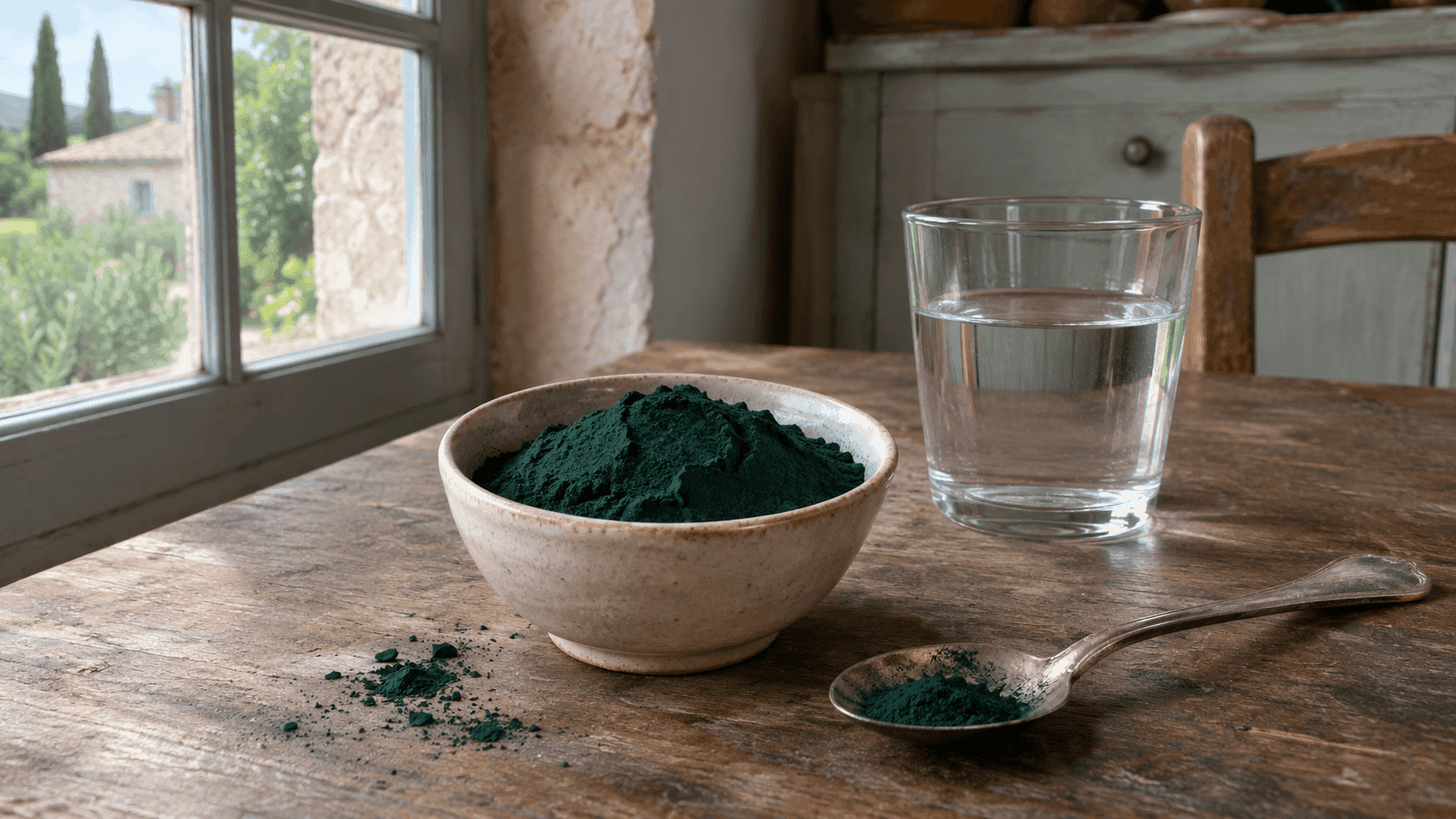
Spirulina is a tiny blue-green organism, made of spiral filaments, that grows in warm, alkaline lakes in hot countries. You don’t pick it: it’s grown in basins, filtered, dried, and it reaches us as powder or flakes. In Chad and Mexico, people have eaten it for centuries. Here, it’s a food or a supplement, and I’ll tell you straight what I know about it.
Her story
Spirulina is a tiny blue-green cyanobacterium that’s dried and eaten as powder or flakes. It’s neither a plant nor a real alga, and you see it everywhere at the moment, often with big promises. Me, I have no promise to make you. I’ll tell you where it comes from, how you take it, and above all who should go without.
Spirulina, what is it?
Under the name spirulina, we group several cyanobacteria of the genus Arthrospira, which used to be called Spirulina. The ones we eat are mainly Arthrospira platensis and Arthrospira maxima. They’re cells stuck one to the next in long filaments twisted into a spiral, and that’s where its name comes from.
It lives in fresh water that is warm, around 25 degrees, and very alkaline. It grows on the surface of lakes and ponds in hot countries: in Africa, in Chad, in Ethiopia; in Latin America, in Mexico, in Peru; in South Asia, in India or Sri Lanka. You won’t find it in your garden, believe me, I looked in the pond.
What colour is spirulina? Blue-green, a very deep green that leans towards blue. That blue can be drawn out on its own to colour sweets and drinks: that’s what’s sold as blue spirulina. Me, I have no use for it, my sweets are made with honey.
Here, spirulina isn’t counted among the plants used for health. In France as in Europe, it’s a food: it’s sold loose, as powder, or as a food supplement. It isn’t in the pharmacopoeia, and my plant books, which give the amount for each tea, don’t mention it. So here, the amounts I give you come from the people who keep an eye on what we eat.
How spirulina is made, from Lake Chad to the basins of France
Around Lake Chad, it has been gathered for a very long time from small lakes and ponds. It’s laid out to dry on the sand and made into dry cakes, dihé, which are used to make broths for meals. There, it’s eaten in a sauce, with millet. In 1967, a Belgian botanist, Jean Léonard, brought these cakes back from an expedition to Chad, and that’s more or less how Europe got to know it.
On the other side of the ocean, the Aztecs skimmed it from the surface of the lakes with ropes, and called it tecuitlatl. The Spaniards who arrived in the 16th century described how it was gathered on Lake Texcoco and the cakes that were sold. One of them wrote that it was eaten the way we eat cheese, with a slightly salty taste. I like that picture of green cheese at the market.
Today, it’s grown almost everywhere. My daughter, who lives in Shanghai, told me that China is by far the biggest producer; I read that it turned out more than sixty thousand tonnes in a single year. She’s more inclined to send me herb of immortality, and I’m not complaining.
In France too, there are spirulina growers. The first commercial farm only opened in 1998. It’s grown in basins a few tens of centimetres deep, often in a greenhouse. So how is spirulina made? The water from the basins is filtered, then it’s drained, washed, sometimes pressed into little strands, and dried. It comes out as strands, flakes or powder.
The benefits of spirulina: what I can tell you, and what I won’t
Everywhere, you read “the ten benefits of spirulina”: energy, hair, cholesterol, menopause, anaemia. I’ll answer you the way I see it. What can be said is that it’s an age-old food, eaten for centuries where it grows, and that its value seems to be mostly as nourishment. For tiredness that lasts, for cholesterol, the most serious things I’ve read say it hasn’t been shown to make any difference. For menopause, hair or nails, I haven’t found anything certain. So I won’t tell you it does.
People also say it’s good for the blood. What I know is that its vitamin B12 is mostly a false B12, which the body can’t use. If you don’t eat any animal products, don’t count on it to give you any. And if you’re pale, out of breath, tired for no reason, it’s not a powder you should be looking for: it’s a blood test, at your doctor’s. For little passing slumps, I’ve written down what I do when tiredness suddenly hits.
Is it good to take spirulina every day? In small amounts, up to a few grams a day for an adult, it doesn’t seem to cause problems, as long as it’s clean. Above 5 grams a day, it already gives more beta-carotene than what’s advised as a supplement. And nobody has set a maximum length of time yet. Me, I keep it small.
Spirulina powder or flakes: how I take it
I’ll be honest: on its own, in a glass of water, I can’t manage it. It has a strong taste that reminds me of the pond in August. So I hide it. The powder mixes well into a yoghurt, a fruit compote, a soup. The flakes, I scatter them over a salad or a bowl of soup, at the last moment, off the heat, and they’re a little crunchy.
The first time, a pinch. After that, 1 to 3 grams in the day, and never more than 5. Weigh it once on your kitchen scales, to see what it looks like in the spoon: it’s much less than you’d think. I keep it in its tightly closed bag, or in a jar, away from light, heat and damp.
Spirulina: the dangers to know, and how to choose it well
The real worry with spirulina isn’t the spirulina itself, it’s what can come along with it. Spirulina products have already been found tainted by toxins from other cyanobacteria, by bacteria, or by metals like lead, mercury or arsenic. It all depends on the water in the basins and the care that goes into it.
People also ask me: is spirulina dangerous for the liver? Cases of liver trouble, and of muscle trouble, have been reported after spirulina supplements, without anyone knowing quite from what amount or after how long. What’s reported most often is tummy trouble and headaches. At the slightest sign that isn’t normal, you stop and talk to your doctor.
To choose it, I take the one whose origin I know: a product that follows French rules, that can be traced, with the maker’s name written on it. An organic French spirulina, from a grower who tells you where and how they grow it, is a good start, without being a guarantee on its own. And everything you need to know before taking any is further down, in the “Caution” part. Read it carefully.
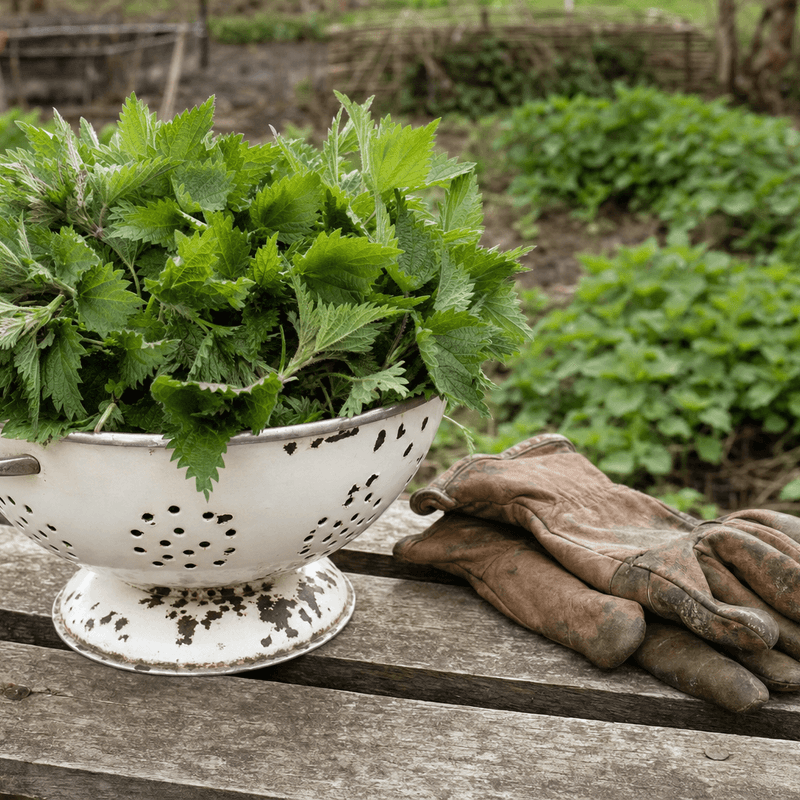
Deep down, I look at it with curiosity, this little blue spiral that has fed people for centuries on the shores of warm lakes. But my green, in spring, is the soup made from the big stinger at the bottom of the garden. At least with that one, I know where it comes from.
What I use her for
- · 01A pinch of powder in my morning yoghurt, mixed first with honey so it doesn’t go lumpy.
- · 02A few flakes on a bowl of soup, off the heat, just as it’s served.
- · 03Never more than 5 g in the day, and 1 to 3 g is plenty for me.
- · 04I get it from someone who tells me where it comes from, with the maker’s name on the bag.
How I prepare her
Granny’s little recipes
The green morning yoghurt
In the morning, at breakfast
What you’ll need
- 1 plain yoghurt (125 g)
- 1 to 2 g of spirulina powder (a little pinch the first time; weigh it once, after that you’ll know by eye)
- 1 teaspoon of honey
- Half a very ripe banana
How I go about it
- 01Mash the half banana with a fork at the bottom of the bowl.
- 02Mix the spirulina with the honey in a small spoon: that way, it doesn’t go lumpy.
- 03Add the yoghurt and stir until it’s all an even, lovely green, a good minute.
- 04Eat it straight away. No more than 5 g of spirulina in the whole day, all recipes included.
The evening soup with spirulina flakes
In the evening, as you serve the soup
What you’ll need
- 1 bowl of homemade vegetable soup (about 250 ml)
- 1 to 2 g of spirulina flakes
- 1 drizzle of olive oil
How I go about it
- 01Make your soup as usual and serve it in the bowl.
- 02Off the heat, at the last moment, scatter the flakes on top.
- 03Add the drizzle of olive oil and eat while it’s hot, the flakes are still a little crunchy.
- 04If you already had some in the morning, count it: no more than 5 g of spirulina in the day.
What to know first
This information doesn’t replace advice from a healthcare professional. Health Disclaimer →
Her identity card
- Name
- Spirulina
- Latin name
- Arthrospira platensis, Arthrospira maxima (formerly Spirulina)
- Family
- Cyanobacteria (it isn’t a plant)
- Parts used
- The whole culture, dried
- Harvest
- Filtered in basins, washed, dried
- Form
- Powder, flakes, strands
- Origin
- Warm, alkaline lakes in Africa, Latin America and South Asia; grown today in basins, including in France
- Storage
- Tightly closed, away from light, heat and damp
If you remember just one thing
- 01Spirulina is neither a plant nor a real alga: it’s a blue-green cyanobacterium that is grown, filtered and dried.
- 02In Chad and Mexico, people have eaten it for centuries; here, it’s a food or a supplement, not a remedy.
- 03In small amounts, up to a few grams a day for an adult, it doesn’t seem to cause problems if it’s clean: never more than 5 g in the day.
- 04Buy it where they know where it comes from, with the maker’s name on it: it can be tainted by toxins, bacteria or metals.
- 05No spirulina with phenylketonuria, a tendency to allergies, fragile muscles or a fragile liver, nor when pregnant, breastfeeding or for children.
Your questions
People with phenylketonuria, those who get allergies easily, and those with fragile muscles or a fragile liver. You also go without when pregnant, when breastfeeding, and for children and teenagers. If you have gout or stones, or if you already take something on a doctor’s orders, ask your doctor first.
In small amounts, up to a few grams a day for an adult, it doesn’t seem to cause problems, as long as it’s clean. Me, I stick to 1 to 3 g, and never more than 5 g in the day. Nobody has set a maximum length of time yet: at the slightest problem, you stop.
It’s an age-old food, eaten for centuries in Chad and Mexico, and its value seems to be mostly as nourishment. For tiredness that lasts or for cholesterol, it hasn’t been shown to make any difference. I’d rather tell you straight than line up ten benefits for you.
I wouldn’t count on it. Its vitamin B12 is mostly a form the body can’t use, so it isn’t a reliable source if you don’t eat any animal products. If you’re pale, out of breath or tired for no reason, what you need is a blood test at your doctor’s.
We know very little. One case was reported where a product to thin the blood worked less well in someone taking spirulina, without anyone knowing whether it had anything to do with it. So if you take something to thin your blood, ask your doctor before taking any.
The one whose origin you know: a product that follows French rules, that can be traced, with the maker’s name written on it. Check that the label really says Arthrospira. There are growers in France, which is a good start. And you never scoop up the green scum from a pond.
References
- Avis relatif aux risques liés à la consommation de compléments alimentaires contenant de la spiruline (saisine 2014-SA-0096) · Anses, 2017
- Compléments alimentaires à base de spiruline : privilégier les circuits d'approvisionnement les mieux contrôlés · Anses, 2017
- Quels sont les bénéfices et les risques de la spiruline ? · Santé.fr, Service public d'information en santé, 2026
- Spiruline · Vidal, 2017
- Spiruline alimentaire · Wikipédia, 2026
- Phycocyanine : qu'est-ce que c'est ? · Futura Sciences, 2026
- Symptômes et diagnostic de l'anémie par carence en fer · Ameli, l'Assurance Maladie, 2026