Soothe winter chilblains
Grandma's remedies for chilblains: warm up gently, no hot water, don't scratch, keep your feet and hands dry and warm. And know when to see a doctor.
Reviewed by Ruosi Wu, PhD in Pharmacy, MD in Traditional Chinese Medicine
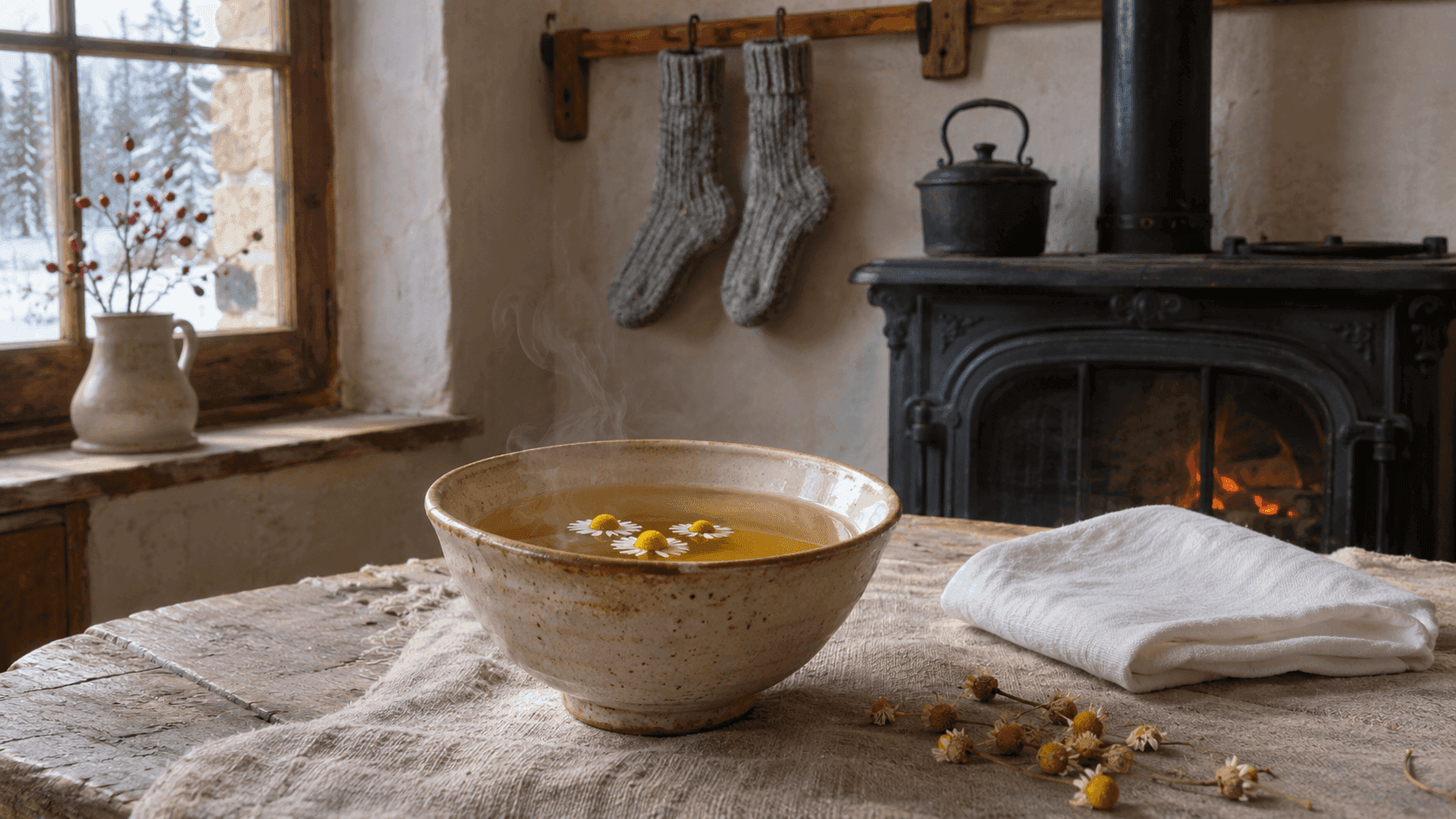
When you have chilblains, warm up gently: pat the skin dry, put on thick socks or mittens, but no hot water and no radiator. Don't rub, don't scratch, and keep your feet and hands dry and warm. Most of the time they settle on their own in a few weeks. If your skin turns white and you can't feel it, or if blisters appear, it's no longer a chilblain: see a doctor.
Key takeaways
- A chilblain is a red or purplish patch, swollen and itchy, on a toe or a finger, a few hours after damp cold: the skin hasn't frozen.
- You warm up gently: pat the skin dry, put on thick socks, but never hot water and never your feet on the radiator.
- No rubbing and no scratching, even when it itches as you warm up. Rubbing snow on your feet is a thing of the past.
- Fingers that turn white then blue, in attacks lasting a few minutes, are something else: Raynaud's phenomenon, to show your doctor in some cases.
- Skin that's white, cold and numb after hard frost, or blisters filled with blood: that's frostbite, you go to A&E.
Granny’s little steps
- Warm up gently
Pat the skin dry and put on thick socks or mittens. Never hot water, never your feet on the radiator.
- No rubbing, no scratching
Not with snow, not with your hand. Even when it itches in the evening, leave the chilblain in peace.
- Keep your feet dry
Dry socks, changed as soon as they're wet, and no shoes that let the water in.
- Dress in several layers
Several layers of clothes, hands and feet well covered, and nothing damp against your skin when you go out in the cold.
- Leave coffee and cigarettes aside
They can upset the blood flow in your fingers and toes. And the little glass of alcohol doesn't warm you.
A recipe to try
The evening lukewarm chamomile compress
In the evening, when the chilblain starts to itch
What you’ll need
- 5 g of dried German chamomile flowers
- 100 ml of water
- A clean cotton cloth
- A dry towel
- Thick, dry socks
How I go about it
- Bring 100 ml of water to the boil and pour it over 5 g of flowers, in a bowl.
- Cover and let it steep for 10 minutes, then strain well.
- Let it cool: on the inside of your wrist it should feel just lukewarm, never hot.
- Soak the cloth, wring it out a little and lay it on the chilblain for a few minutes, without rubbing.
- Pat dry with the towel and put on dry socks straight away.
- You can do it again several times a day. Not under 12, not on broken skin, a blister or a crack, and if it isn't better after a week, show it to your doctor.
Chilblains calm down with gentleness and a little patience: you warm up slowly, you don't rub, you don't scratch, and you keep your feet and hands dry and warm. I'll tell you how to recognise them, how not to mix them up with two more serious things, what I do at home, and when it's time to see someone.
Chilblains on the feet and hands: what they look like
A chilblain is a red patch, sometimes purplish, that swells and itches. Most often it settles on the toes or fingers, but it can also take the nose or the ears. It shows up a few hours after you've been out in the cold, and it itches, or burns a little.
What surprises people is that it itches even more as you warm up. In the evening, feet under the eiderdown, that's when it pulls at you. It doesn't mean it's getting worse: that's just what chilblains do.
The good news is that they go away on their own, in a few weeks, often two to three. You just mustn't wake them up every day with a fresh dose of cold.
Why chilblains come, even without frost
People think chilblains mean frost. Not at all. They come with damp cold, around 8 to 10 °C: the fine November rain, shoes that let the water in, wet socks you keep on all day. The skin reacts to the cold, it doesn't freeze.
The books explain that cold tightens the little blood vessels in the fingers and toes, and that it's when you warm up that the redness, the pain and the itching arrive.
At home, in the evening, my mother lined up our wet socks above the stove, and we weren't allowed to put the morning's pair back on. I do the same: dry socks, always.
Chilblain, Raynaud's or frostbite: don't mix them up
Two things look a bit like chilblains and aren't handled the same way at all. So here's how I tell them apart.
The chilblain: a red or purplish patch, swollen, itchy, that stays for days, sometimes weeks. It comes with damp cold, not necessarily with frost.
Raynaud's phenomenon: this one comes in attacks. Suddenly, in the cold, but also with strong emotion or stress, the fingers turn white and cold, and you can't feel them properly. Sometimes they go blue, with pins and needles or a little pain. Then the colour comes back, red, warm, a bit swollen, and everything returns to normal in a few minutes. Most often it affects the fingers of both hands, rarely the thumb, and it isn't serious. But some signs should make you book an appointment with your doctor: I've put them in the list further down.
Frostbite: now that's real frost, the tissues themselves freeze. At first the skin turns white and cold, numb, it tingles, but it doesn't hurt: that's a warning. Then the skin reddens, swells, and blisters filled with blood may appear, then cracks and sores. When you can't feel anything any more and the cold doesn't even hurt, that's a sign of something serious. Frostbite with blisters means A&E straight away.
And if what bothers you is having icy hands and feet all winter, without a red itchy patch, that's something other than chilblains again.
What to do about chilblains: my little steps
First, dry and warm up gently. I take off the wet socks, pat my feet dry with a towel, without rubbing, and put on thick, properly dry socks. For the hands, mittens or gloves.
What I don't do: feet on the radiator, or under the hot tap. It's tempting, I know. But you have to warm up slowly, and very hot water can burn.
Next, no rubbing and no scratching. My grandmother used to rub our feet with snow when we came home frozen from school. Today we know you mustn't rub, not with snow, not any other way. And even when it itches in the evening, you don't scratch: you leave the chilblain in peace.
And for the days after, you keep it out of the cold. Several layers of clothes, hands and feet well covered, thick socks, mittens, and nothing damp against the skin: shoes that let the water in, I leave at home.
Two more little things. The little glass "to warm you up" doesn't warm you. And coffee, tea or cigarettes can upset the blood flow in your fingers and toes: when I have chilblains, I switch to a caffeine-free cup.
Grandma's remedies for chilblains, and what I keep of them
I'll be honest: I don't know of any plant that makes a chilblain disappear. It goes with time and gentle warmth. Plants, at my house, just make the evening more pleasant.
Chamomile, as a lukewarm compress. The books give chamomile compresses when the skin is a little inflamed. I steep 5 g of flowers in 100 ml of boiling water, ten minutes with a lid on, strain it well and let it cool to lukewarm. Then I lay a soaked cloth on the chilblain, without rubbing. Only on skin that isn't broken, not under 12, and not if you're allergic to plants of the daisy family. The recipe is just below, and everything else I do with chamomile is over here.
Rosemary, in the bath, but not just any time. The old manuals give the rosemary bath for small circulation troubles: 50 g of leaves, as a decoction in a litre of boiling water or straight into the bathtub, water between 35 and 38 °C, ten to twenty minutes, two or three times a week. But they also say: never on damaged or irritated skin. So on a red, itchy chilblain, no. I keep it for the evenings when I come home frozen to the bone and my skin is fine. My garden rosemary, I tell you about it here.
Ginger, in the cup. Since I leave coffee aside, I make myself a cup of ginger and lemon on cold days: a tablespoon of freshly grated ginger in 30 to 40 cl of just-boiled water, the juice of half a lemon, ten minutes with a lid on. It does nothing to the chilblain, I won't tell you stories, but it warms your hands around the cup. Not during pregnancy or breastfeeding, and not under 18. Ginger and my winter cups, it's here.
"A chilblain, you warm it without rushing it, you leave it in peace and you give it time."
Which plants?
GingerZingiber officinale
Ginger is the hot, peppery rhizome of a tall Asian plant. At my place, it goes in the cup with lemon, into dishes grated at the last minute, and into the gingerbread.
RosemarySalvia rosmarinus
Rosemary is the evergreen Mediterranean shrub you keep close to the kitchen: for the potatoes, for a cup after a meal, for the bath.
ChamomileMatricaria chamomilla L.
Chamomile means two little flowers for your cup: German chamomile, mild, and Roman chamomile, bitter. For a bloated tummy, an irritated throat, skin that's got too hot.
What to know first
Heat: warm up slowly. No feet or hands on the radiator, no hot tap water: very hot water can burn.
If it's frostbite: (white, cold, numb skin after hard frost), the steps change: take off rings and bracelets, warm up gradually (your hand under your armpit, in a blanket, or in a water bath at 37-40 °C for an hour, keeping it at 37 °C throughout), no hair dryer or fan heater, don't rub, don't massage, and don't let the area freeze again. With blisters, go straight to A&E.
Scratching and rubbing: don't scratch, don't rub, not even with snow: you damage the skin.
Alcohol: it doesn't warm you: it makes you lose heat and dulls the warning signs of cold. No alcohol before going out.
Tobacco, coffee and some medicines: cigarettes, caffeinated drinks and decongestant medicines can upset the blood flow in your fingers and toes. If you take them, ask your pharmacist.
Diabetes: if you have diabetes, show chilblains on your feet to your doctor: for you, foot problems can be more serious.
Older people and long-term conditions: be even more careful with the cold if you're older, don't move around much, or have a long-term condition.
Chamomile compresses: not under 12, and not if you're allergic to chamomile or to plants of its family, the Asteraceae, the daisy family. Severe allergic reactions have been reported: if you have trouble breathing, or your face or throat swells, call 15 (the French emergency number) at once. Keep away from the eyes. Not on a blister or broken skin: that's for the doctor. If it isn't better after a week, or if it gets worse, go and see them.
Rosemary baths: never on damaged or irritated skin, so not on a chilblain. Not under 12, not during pregnancy or breastfeeding. With high blood pressure, be careful with a full hot bath. Rosemary can cause a skin allergy (contact eczema): if that happens, stop. Inflamed skin, a wound, a leg that suddenly swells, red and hot, a sudden sharp pain in the leg at rest, a weak heart or kidneys: ask your doctor first. If it isn't better after four weeks, go and see them.
Ginger: it can upset the stomach, cause burping, heartburn or nausea. Not if you're allergic to it. Not during pregnancy or breastfeeding, not under 18. If you take a treatment to thin the blood, have gallstones or have an operation planned, ask your doctor before drinking it regularly.
When to see your doctor
- After hard frost, your skin is white and cold, you can't feel it and it doesn't even hurt: that's a sign of something serious, go to A&E or call 15 (the French emergency number).
- After being out in the cold, blisters appear, especially filled with blood: go straight to A&E.
- In the hours after warming up, the skin turns blue or blood blisters appear: get urgent medical care.
- Your chilblain isn't getting better after 2 to 3 weeks: see your doctor.
- Pus is coming out of your skin: see your doctor.
- Along with your chilblain, you have a high fever, or you feel hot then cold with shivers: see your doctor.
- Your chilblains keep coming back: talk to your doctor.
- You have diabetes and a chilblain on your foot: show it to your doctor.
- Your fingers turn white or blue in attacks, and the first attack came after age 35: book an appointment with your GP.
- You're a man and you have these attacks of white fingers: book an appointment with your GP.
- The attacks affect only one side of your body, or not both hands the same way: book an appointment with your GP.
- Your thumb turns white too during attacks: book an appointment with your GP.
- The attacks come on their own, without cold: book an appointment with your GP.
- With these attacks, you have trouble swallowing, or a dry mouth or dry eyes: book an appointment with your GP.
- With these attacks, your joints hurt, you have small sores on your fingertips, or fingers that swell up like sausages: book an appointment with your GP.
- The attacks are slowly getting worse: book an appointment with your GP.
- You have these attacks and you're being followed for a long-term illness: book an appointment with your GP.
- You have these attacks with tiredness or muscle pain that worries you: book an appointment with your GP.
- You have these attacks and a risky job or intense sport: book an appointment with your GP.
- You have these attacks and you take medication, even eye drops: book an appointment with your GP.
Your questions
Chilblains: what should I do?
Pat the skin dry, warm it gently with thick socks or mittens, with no hot water or radiator. Don't rub, don't scratch, and keep your feet and hands dry and warm over the following days. Most of the time they settle on their own in two to three weeks.
How can I soothe chilblains on my feet?
Thick, dry socks, changed as soon as they're damp, shoes that don't let the water in, and no feet on the radiator. In the evening, when it itches, I lay a lukewarm chamomile compress, without rubbing, on skin that isn't broken. And I leave coffee and cigarettes aside.
What causes chilblains on the feet?
Damp cold, around 8 to 10 °C, more than frost: wet feet that stay out in the cold. The skin reacts, it doesn't freeze. The patches come a few hours later, and they itch most as you warm up.
How long does a chilblain last?
A few weeks, often two to three, as long as you don't put it back in the cold. If it isn't better after 2 to 3 weeks, if pus comes out or if your chilblains keep coming back, see your doctor.
Chilblain or Raynaud's phenomenon: how do I tell the difference?
A chilblain is a red or purplish patch that swells, itches and stays for days. Raynaud's phenomenon comes in attacks: the fingers turn white and cold, sometimes blue, then red, and everything returns to normal in a few minutes. If the attacks start after 35, affect one side only or include the thumb, book an appointment with your doctor.
Can I put my feet in hot water when I have chilblains?
No, not in hot water. You warm up gently, with thick dry socks, no radiator and no very hot water, which can burn. And if your skin is white and you can't feel it after hard frost, it may be frostbite: then you go to A&E.
References
- Les gelures, des lésions à traiter rapidement · ameli.fr, 2026
- Bien se protéger du froid · ameli.fr, 2026
- Phénomène de Raynaud : définition, symptômes et causes · ameli.fr, 2026
- Doigts blancs et froids : que faire et quand consulter ? · ameli.fr, 2026
- Chilblains · NHS, 2026
- Gelure (version pour le grand public) · Manuel MSD, 2025
- European Union herbal monograph on Matricaria recutita L., flos (EMA/HMPC/55843/2011) · European Medicines Agency, HMPC, 2015
- European Union herbal monograph on Rosmarinus officinalis L., folium, Revision 1 (EMA/HMPC/513940/2021) · European Medicines Agency, HMPC, 2024
- European Union herbal monograph on Zingiber officinale Roscoe, rhizoma, Revision 1 (EMA/HMPC/885789/2022) · European Medicines Agency, HMPC, 2025
Information. This information is provided for general knowledge and doesn’t replace medical advice. Check with a healthcare professional before any use.
Health Disclaimer