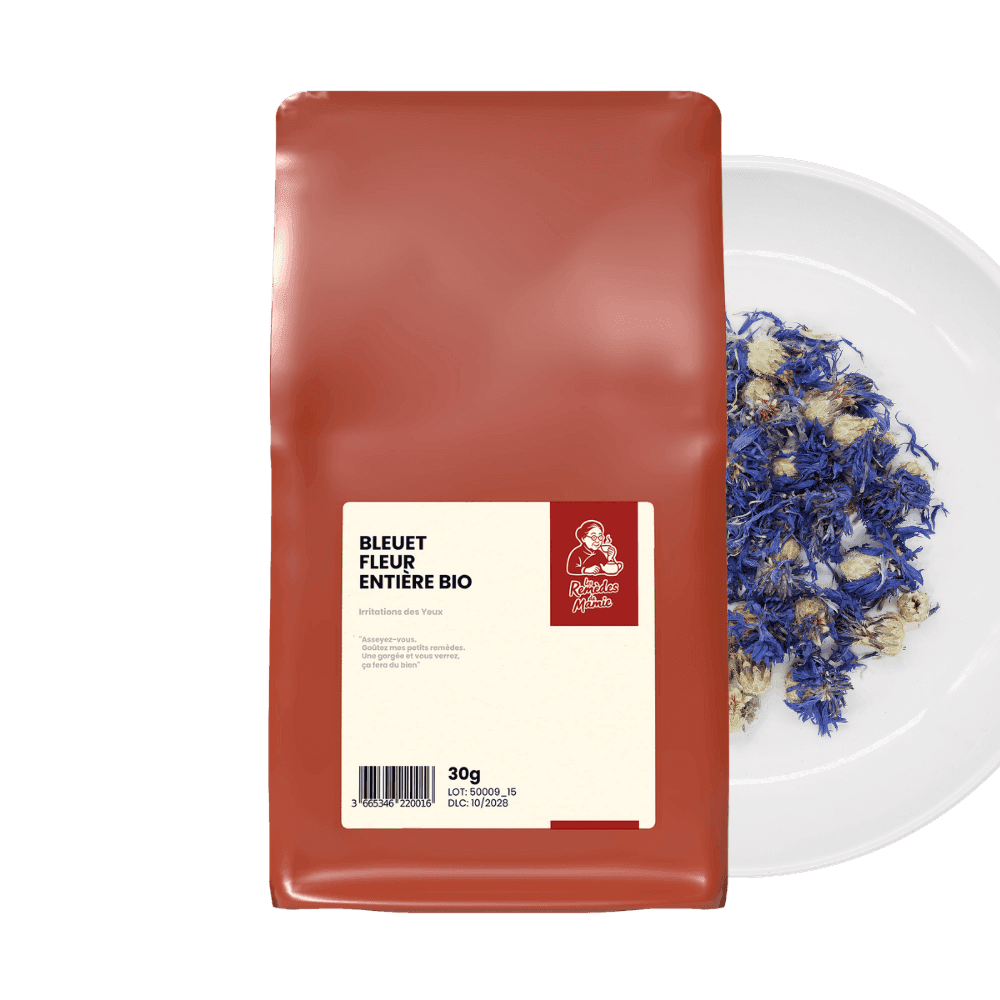
ORGANIC WHOLE CORNFLOWER
Whole organic cornflower, the little blue flower of the wheat fields: a pinch to colour your herbal teas, a few petals on your desserts.
What to know
Cornflower is that little blue flower that grows in the middle of wheat fields. Its scientific name is Centaurea cyanus, and it's from the same family as chamomile and daisies. In this bag you get the whole flower, dried, organic: the flower head with all its blue.
In the old days, people used its water to bathe irritated eyes and eyelids. They even called it the “casse-lunettes”, the glasses-breaker. The pharmacopoeia still lists it among traditional plants. But for the eyes, I haven't found in the books either a way to make it, or an amount, or a length of time. So I don't put it on my eyes anymore, and I don't advise you to. For the evenings when your eyes feel strained, I've told you what I do instead.
These days, I use cornflower for the colour. It goes into some teas, like Lady Grey, and its flowers are edible: a few petals on a fruit salad, a mousse or a cake, and the whole table looks different.
And then there's the Bleuet de France, the one people wear in their buttonhole around 11 November and 8 May. During the Great War, cornflowers kept flowering in fields churned up by shells, the only touch of colour in the mud, and the very young soldiers were called “bleuets”. That cornflower is a badge, sold to help veterans. Mine goes in the teapot.
What's inside
Cornflower whole flower (Centaurea cyanus) 30g.
How I use it
In a herbal tea: a pinch of flowers added to your other plants, in the teapot, when you pour in the hot water. Cornflower is mostly there for the colour.
In the kitchen: a few flowers or petals scattered at the last moment over a fruit salad, a mousse or a cake.
I'm not giving you an amount for drinking it on its own, as a plant in its own right: the books I've read don't give one. And never on the eyes, not as a compress or as an eye bath. If you want to use it some other way, ask your pharmacist.