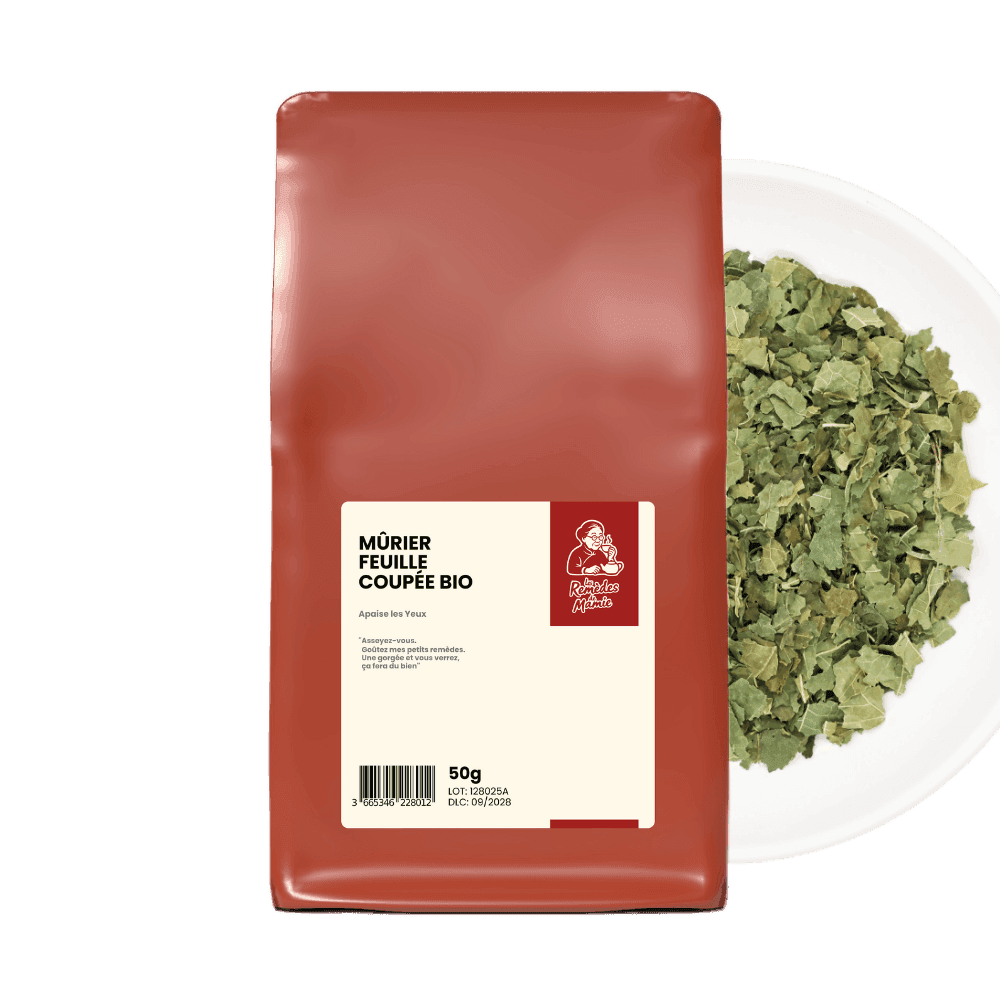
ORGANIC CUT MULBERRY LEAF
Cut and dried leaves of the white mulberry, the silkworm's tree. In China, they're drunk as a tea when your head spins or your eyes turn red.
What to know
The mulberry leaf in this bag is the leaf of the white mulberry, Morus alba, cut and dried. The white mulberry comes from China, and it's the silkworm's tree: its leaves are the only thing the silkworm eats. In this bag, there are 50 g of cut leaves, organic.
Here in France, it was planted for silk. Growing it began under Charles IX, and Henri IV encouraged it with Olivier de Serres, who had a first one brought to the Tuileries in 1601. Its fruits, little sweet berries, can be eaten too.
In China, the leaf is picked after the first frosts. In the Chinese pharmacopoeia, it's drunk when a cold comes with a fever, when the cough is dry, when your head spins or aches, and when your eyes are red and your sight goes blurry. Over there, it also goes into tea and into cooking. In Europe, I haven't found an official book that recognizes a use for it: what I tell you comes from the Chinese pharmacopoeia.
For evenings when your eyes feel strained after a long day, I have other little tricks for tired eyes. And a red, painful eye with blurry sight means the eye doctor the same day, not a tea.
What's inside
White mulberry cut leaf (Morus alba) 50 g.
How I use it
Mulberry leaf tea (during the day, in two or three cups): 5 to 10 g of leaves for the whole day, that's the amount in the Chinese pharmacopoeia. For each cup, count 2 to 3 g of leaves and 150 ml of water. Pour the boiling water over the leaves, cover with a saucer and let it steep 10 minutes. Strain and drink. No more than 10 g of leaves in a day.
If you take something on a doctor's orders to bring down your blood sugar, talk to your doctor first. Not during pregnancy or breastfeeding, not for children. Beyond three months in a row, the books have no track record.