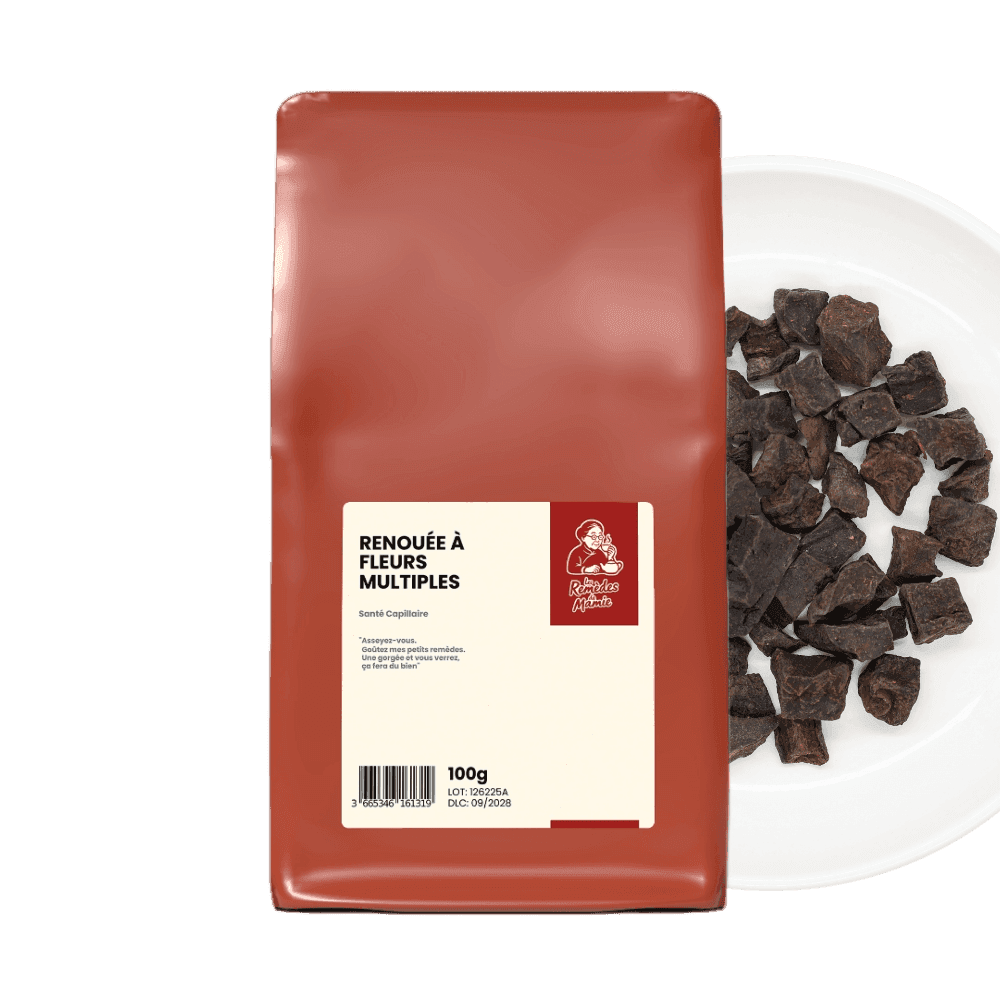
FO-TI (MULTIFLORA KNOTWEED)
The dried root of multiflora knotweed, Chinese he shou wu. Careful: it has damaged people's livers, and in France the official advice is to avoid taking it.
What to know
Multiflora knotweed is a climbing vine from the Far East (China, Taiwan, Vietnam) that grows from a big root. You'll find it under lots of names: he shou wu, fo-ti, Polygonum multiflorum, Fallopia multiflora or Reynoutria multiflora. In this bag there are 100 g of roots, of Chinese origin, pharmacopoeia quality.
In China, it has long been given as a tonic, and against the signs of age, especially when hair is falling out. That's why people look for it so much today, for lovely hair.
But I'll tell you how things are. This root has been linked to many cases of liver damage, in China and elsewhere, even acute hepatitis. In France, the official advice is to avoid taking it, and the French pharmacopoeia lists it among the plants whose risks outweigh their benefits. I'd rather tell you straight than tell you a story.
So for this one, I'm not giving you a way to prepare it at home. If you're set on taking it, or if someone recommended it to you, talk to your doctor or your pharmacist first. And don't confuse it with Japanese knotweed: that's a different plant.
What's inside
Fo-ti, multiflora knotweed (He shou wu, Polygonum multiflorum) 100 g, of Chinese origin, pharmacopoeia quality.
How I use it
For this one, I'm not giving you an amount or a recipe. It has damaged people's livers, no one can set a dose that's free of risk, and in France the official advice is to avoid taking it. If you still want to use it, ask your doctor or your pharmacist first.
If you've already taken some and you feel great tiredness for no reason, or nausea, or you notice dark urine, or your skin and the whites of your eyes turning yellow, stop right away and call your doctor that same day.