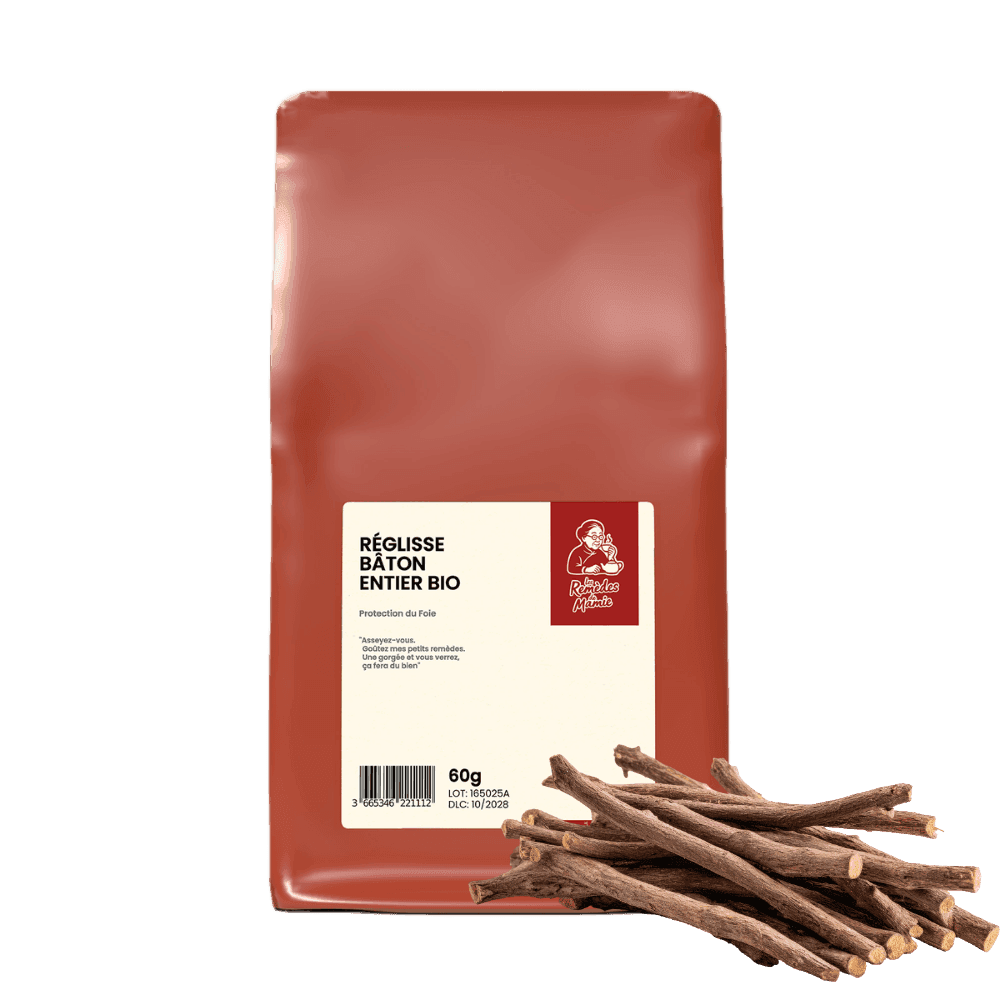
ORGANIC WHOLE LIQUORICE STICK
Whole liquorice sticks, the sweet root people used to chew, to simmer now and then after a meal when your stomach burns. Never more than 4 weeks.
What to know
A liquorice stick is a piece of dried liquorice root, Glycyrrhiza glabra, a plant from southern Europe and Asia. Its name comes from Greek: the “sweet root”. In this bag there are 60 g of whole sticks, organic.
In the old days, people simply chewed the sticks. And in Paris, they used to sell coco in the street, a cheap liquorice drink. Today, the books recognise two traditional uses for it as a herbal tea: a cup after a meal, when your stomach burns or digestion feels heavy, and a cup when a cold makes you cough.
But liquorice is sweet and seems like nothing at all, and that's exactly why you have to be careful. Taken for too long or in too large amounts, it makes you hold on to water, lowers your potassium, pushes your blood pressure up, and your heart can start beating out of rhythm. And it's everywhere: in pastis (our aniseed aperitif), even the alcohol-free kind, in sweets, syrups, some herbal teas. Me, on the day I drink my cup, I don't double up.
For meals that sit on your stomach, I have other little habits for heavy digestion.
What's inside
Whole liquorice stick (Glycyrrhiza glabra) 60 g.
How I use it
The after-meal liquorice cup (now and then, after a meal, when your stomach burns or digestion drags): break the stick into bits and put them in a small pan of cold water. Bring to the boil, then let it simmer gently 15 minutes. Strain and drink. Ask your pharmacist how much root to use: with liquorice, a single cup quickly goes over what's advised for the day. Me, it's a cup now and then, not every day.
Never more than 4 weeks. If your stomach still burns after 2 weeks, or if it gets worse, go and see your doctor. No tea under 18, and no liquorice at all, in any form, during pregnancy or breastfeeding, or if you have high blood pressure, or a delicate heart, kidneys or liver.