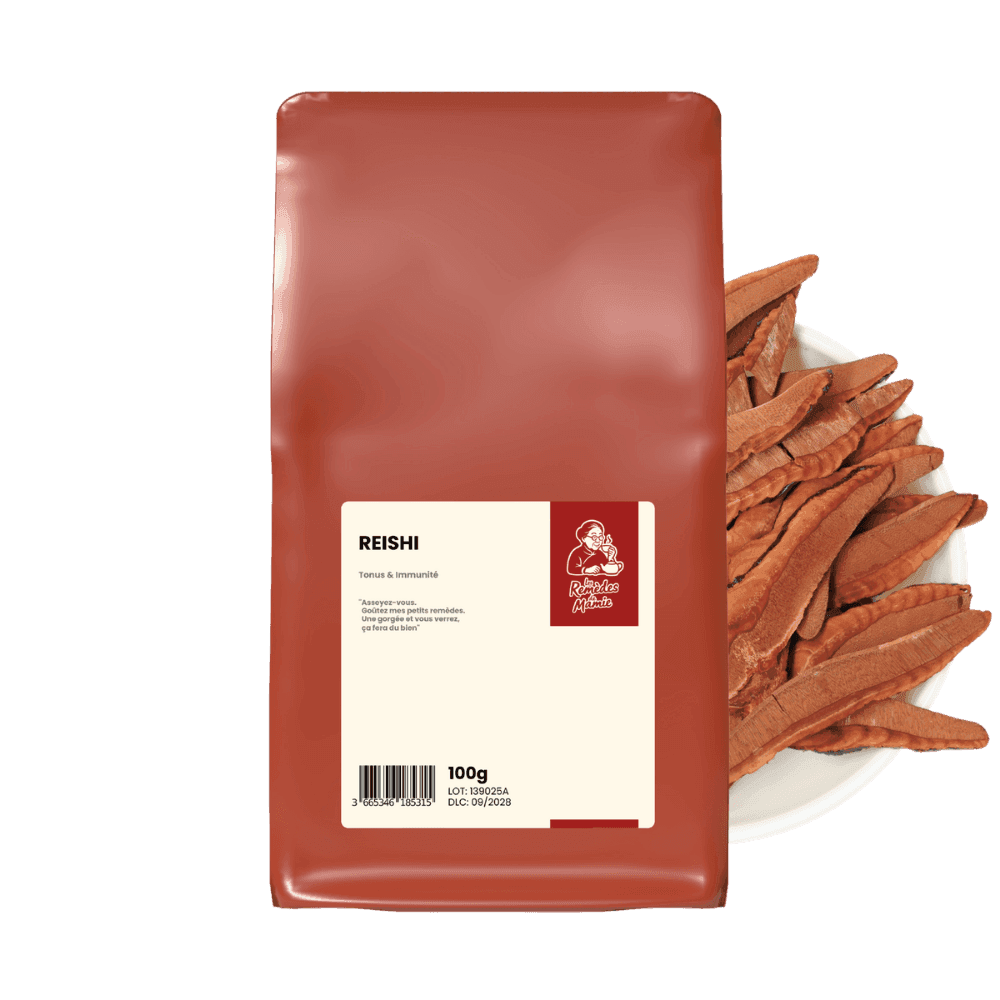
REISHI MUSHROOM
Reishi is lingzhi, a mushroom that grows on wood, with a cap that looks varnished. In China, people simmer it a long time when they sleep badly and feel weary.
What to know
Reishi is a mushroom, not a plant: the shiny ganoderma, Ganoderma lucidum. Reishi is how the Japanese read its Chinese name, lingzhi. It grows at the foot of broadleaf trees, on their stumps and roots, and you even find it here, from June to November. The one in my bag comes from China.
It has a kidney-shaped cap, reddish brown and shiny as if it had been varnished, sitting on a stem off to one side. Turn it over and you've got a little wooden ladle. My friend Keiko wrote to me that in Japan they give it all sorts of ladle names, and that around Kyoto or Yamaguchi it's also called the departure mushroom: people hung it at the doorway when someone was setting off on a journey, to bring them luck. Me, I keep mine in a jar, but I like the idea.
In China, it has had a special place for a very long time: an old plant book, written about eighteen centuries ago, already sorted it into six colours. Today, the Chinese pharmacopoeia lists it among the things you take when the mind is restless, you sleep badly and feel weary, with no appetite. The European books say nothing about it. Tough and bitter, it's not for cooking: you simmer it a long time and drink the broth.
What's inside
Reishi (Ling zhi, Ganoderma lucidum) 100 g, of Chinese origin, top quality.
How I use it
The books over here give no amount for reishi, so I don't give you one: if you want to take some, ask your doctor or pharmacist first. Where people use it, they put the slices in cold water, bring it to the boil, then let it simmer with the lid on for at least 30 minutes, and sometimes up to two hours.
The broth is dark and bitter; I add a little honey. I don't take it for long, and if my sleep or tiredness hasn't improved after two weeks, I go and see my doctor.