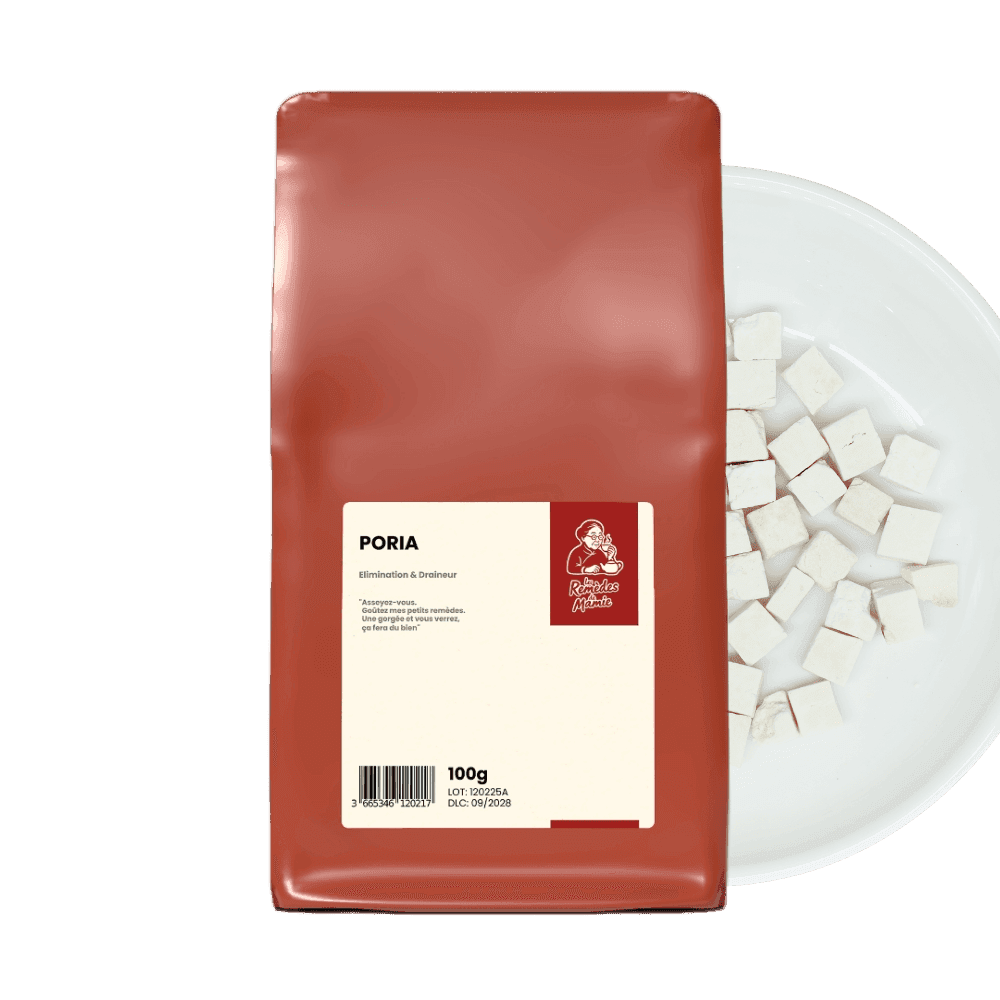
PORIA MUSHROOM
Poria is fu ling, a mushroom that grows into a big hard ball underground. In China, people simmer it when they sleep badly or eat little.
What to know
Poria isn't a root or a plant: it's a mushroom, the Chinese fu ling, which in French we call pachyme. What we keep is its sclerotium, a big hard ball that forms underground, a bit like a small coconut. Outside, a thin, brown, wrinkled skin; inside, white flesh, sometimes a little pinkish, now and then with a bit of pine root caught in the middle.
It's dug up in summer, from July to September. Then it's left to “sweat” in a heap, spread out to dry, and the whole thing starts again several times, until it wrinkles; then it's peeled and cut into cubes or slices. It has hardly any smell, a very quiet taste, and it sticks a little to your teeth when you chew it.
In Beijing, they put it in the batter of thin pancakes rolled around walnuts and honey, fuling jiabing, which used to be served at court. In the Chinese pharmacopoeia, it's filed among the things people take when they eat little, and when they sleep badly, with a restless mind. The European books say nothing about it: I'm giving you what the Chinese pharmacopoeia says, no more, no less.
What's inside
Poria (Fu ling, Poria cocos) 100 g, of Chinese origin, pharmacopoeia quality.
How I use it
For the day, I count 10 g of poria cubes: that's the low end of what the Chinese pharmacopoeia gives. I put them in 500 ml of cold water, bring it to the boil, then let it simmer for 20 minutes with the lid on.
The broth is pale and almost tasteless: I drink it in two cups, and into the evening one I'm happy to stir a spoonful of honey. The books set no length of time: I take it in spells, and if my sleep wasn't any better after two weeks, I'd go and see my doctor.