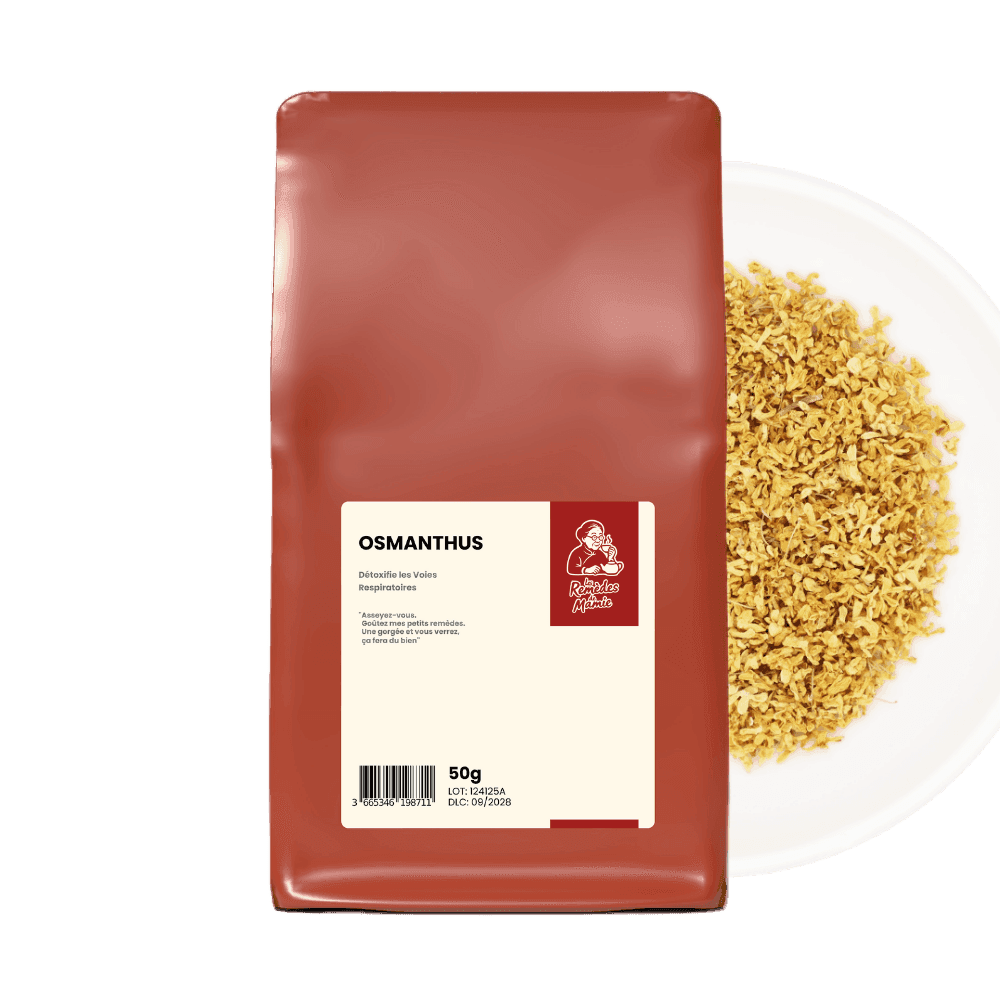
SWEET OSMANTHUS FLOWERS
Dried osmanthus flowers, from China's sweet olive, with a scent of apricot: a spoonful in your tea, or a little scented honey for winter.
What to know
Osmanthus, or sweet olive, is a shrub from East Asia, of the same family as the olive tree. In Chinese, it's called gui hua. Its name comes from Greek and means “fragrant flower”. In this bag, there are its little dried flowers, nothing else.
It flowers in September and October, for only ten days or so. Its flowers are tiny, but their scent brings apricot to mind. My daughter, in Shanghai, wrote to me that over there it goes with the Mid-Autumn Festival, because that's when it blooms. Me, what I love is opening the bag on a November afternoon, when the garden has nothing left to smell.
In China, it's used mostly in cooking: to scent tea or wine, in cakes, soups, jams and jellies. The old Chinese books count it among their plants too, but I keep it for the scent, and that's already a lot.
What's inside
Sweet osmanthus (Gui hua, Osmanthus fragrans) 50 g, of Chinese origin, pharmacopoeia quality.
How I use it
As a tea: a teaspoon of flowers, rinsed quickly in hot water, for 250 ml of water at about 85 °C, for 2 to 3 minutes. No longer, or it turns bitter.
In tea: a pinch of flowers added to your tea, in the teapot.
As scented honey: 2 tablespoons of flowers in a small jar, scalded and dried well, then 4 tablespoons of honey poured in bit by bit, so the flowers soak it up. Close it, and leave it 2 to 3 days in the fridge. A teaspoon of this honey in a big cup of boiling water, and it's ready.
A cup now and then, for the pleasure: I don't make a daily course of it.