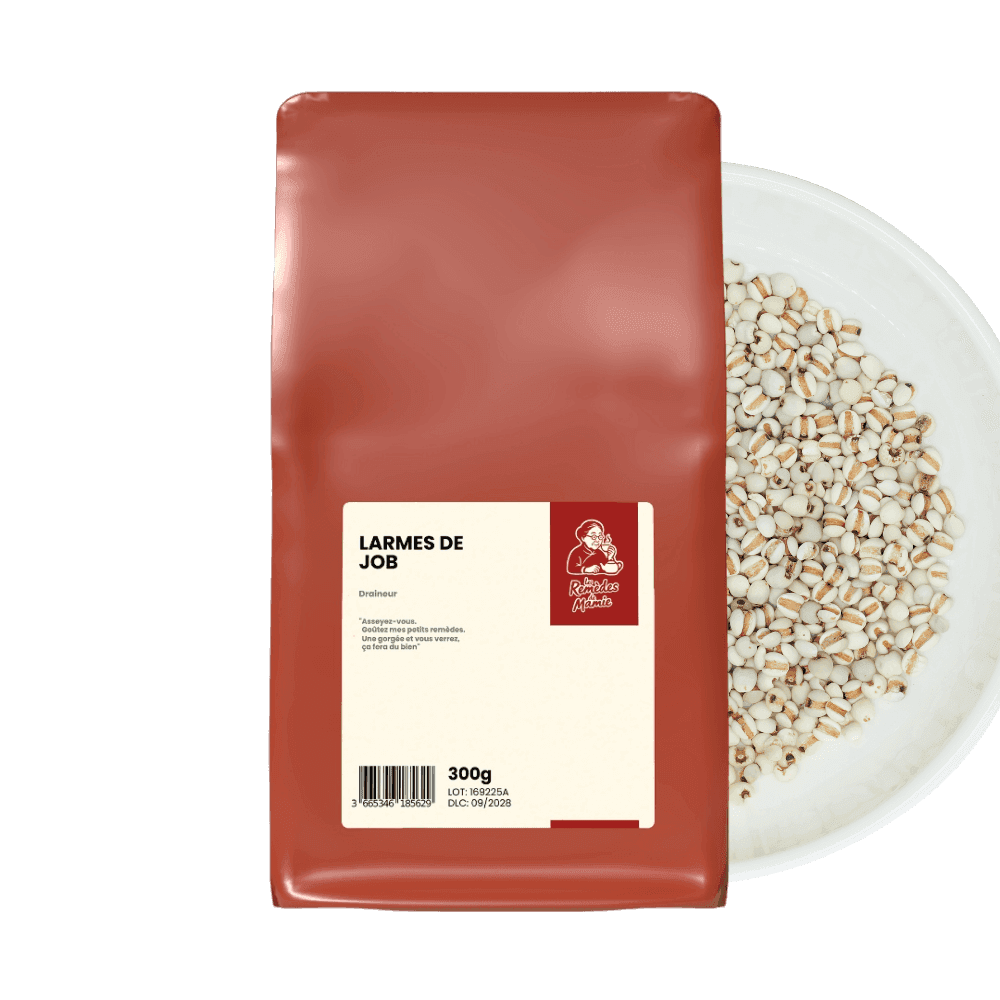
JOB'S TEARS
Job's tears are the hulled grains of a tall grass from Asia. I soak them, then cook them in a soup, 9 to 30 g a day.
What to know
Job's tears is a tall grass of the grass family, from Southeast Asia, grown in China and India since ancient times. Its name comes from its seeds, which are shaped like a tear. It's said that Arab merchants brought it to Europe in the Middle Ages, with this name of Job's tears, and Linnaeus kept it in Latin: lacryma-jobi.
There are two kinds. The wild one has a hard, shiny shell, like a pearl: people have always made rosaries and necklaces from it, hence its other French names, herbe à chapelets (rosary grass) or larmille. The cultivated one has a soft shell: it's hulled and the grain is eaten. That's the one in the bag, the one the Chinese pharmacopoeia calls yì yǐ rén.
In China, the grains are simmered in water for a sweet, slightly cloudy drink, or in dessert soups. In Japan, they're roasted for a tea, hatomugi-cha. The old Chinese books gave it when people felt heavy and puffy with water. Me, I like it in soup, for its tender grain that stays a little firm when you bite into it.
What's inside
Job's tears (Yi yi ren, Coix lacryma-jobi) 300 g, of Chinese origin, pharmacopoeia quality.
How I use it
The Chinese pharmacopoeia gives 9 to 30 g a day. That's less than in a lot of recipes, so I weigh it.
I rinse the grains and let them soak in cold water for at least 20 minutes. Then I cook them over a low heat in 500 ml of water, until they're tender and plump: that can take an hour. I eat the grains and drink the broth.
You can also add them to a vegetable soup, the way you would with rice.
Once a day, staying within 9 to 30 g. And during pregnancy, I don't take it.