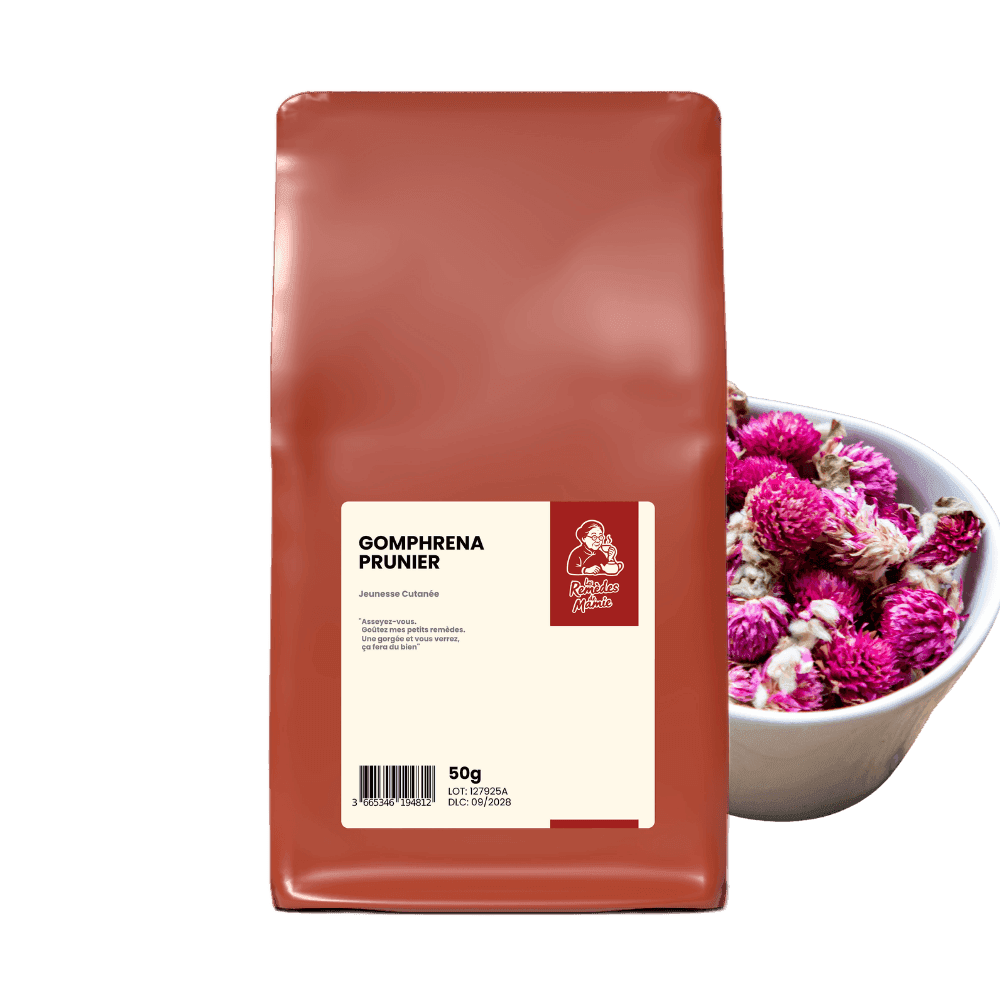
GLOBE AMARANTH
Dried flower heads of gomphrena, the little globe amaranth that keeps its colour. Not a plum tree: just a small flower to steep now and then.
What to know
Despite its name, gomphrena prunier is not a plum tree (prunier is French for plum tree). It's globe amaranth, Gomphrena globosa, a little flower as round as a marble, from the amaranth family. The word “prunier” comes from its Chinese trade name, hong qiao mei. In the bag, that's all there is: the dried flower heads.
It comes from tropical America, from Mexico to Brazil. Here it can't take frost, so we sow it every spring as an annual, and it flowers from June to October. Once dried, it keeps its shape and its colour: people make dried bouquets with it for the winter. In China they call it qian ri hong, “thousand-day red”, and the name suits it.
An old Chinese herbal from the 19th century already says that in winter, when its leaves have withered, its flower still hasn't wilted, and that women pinned it in their hair. The European books, though, give it no recognised use and no amount. So I keep things modest with it: a cup now and then, for its colour, and that's all.
What's inside
Globe amaranth (Hong qiao mei, Gomphrena globosa) 50 g, of Chinese origin, pharmacopoeia quality.
How I use it
I quickly rinse 3 to 5 dried heads in cold water, put them in a cup and pour 200 to 250 ml of water that has just boiled over them. I cover it and let it steep 5 to 7 minutes: the water turns pink.
A cup now and then, not every day: I don't take it as a course. The books give no amount, so I have it as a flower drink, nothing more.